The In-Ring Truth: Technical Breakdown — How the Soviet-Style Defense Neutralized the Mexican Superstar
Many people only look at whether “heavy punches land,” but to understand how Bivol won, the key lies in his feet. Before the fight, Canelo was an unstoppable force at 168 lbs, relying on his highly oppressive forward-marching footwork and his signature liver shot. But Bivol used three strategies to completely neutralize Canelo’s arsenal:
1. Textbook Distance Control
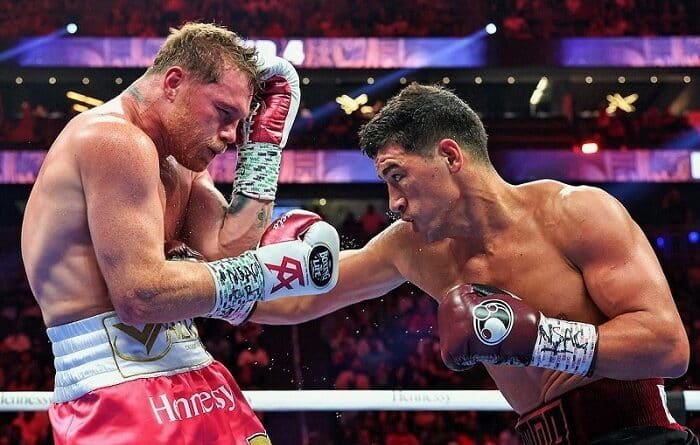
Bivol comes from the authentic Soviet amateur boxing system, where the deadliest weapon is the “Pendulum Step.” For 12 full rounds, Bivol’s legs worked like a well-oiled machine. Whenever Canelo tried to get inside, Bivol would subtly retreat a half-step; the split second Canelo missed and was caught between motions, Bivol would slide right back in. Canelo couldn’t even touch the hem of his shirt, making it impossible to establish an offensive rhythm. Bivol’s lead jab wasn’t just a measuring stick; it was a wrecking ball that constantly disrupted Canelo’s setups.
2. The "You Fight Yours, I Fight Mine" Combination Logic
Canelo’s head movement and counter-punching are world-class. Team Bivol saw right through this and devised a highly counter-intuitive strategy: absolutely no single power punches. Every time Bivol threw, it was a 1-2 (jab-cross) or a 1-2-3 combination. Canelo could slip the first and second punches, but by the third and fourth, he was forced to eat the shots or shell up in a high guard. Numbers don’t lie—Canelo’s punch output and landing rate plummeted to a career-low that night because he spent the entire fight defending against Bivol’s machine-gun-like barrages.
3. Cracking the "Arm-Punching" Tactic with an Iron Wall
Canelo previously used the “arm-punching” tactic to batter Callum Smith’s left arm until it went numb and useless. Facing Bivol, he tried to repeat the trick, relentlessly hammering Bivol’s left arm. But Bivol’s tactical discipline was terrifying. Like a pain-free iceman, his high guard remained glued to his chin from start to finish. The deadliest part? In the fraction of a second Canelo took to pull his arm back after a strike, Bivol would immediately counter. Punching the arms proved not only ineffective, but it also left Canelo exposed to a frenzy of counterattacks, driving him to pure despair.
Outside the Ring Grudges: Storytelling — The Arrogant King and the Cold Iceman
The most fascinating part of boxing is the clash of personas behind the scenes. This fight was essentially a script about “Pride and Prejudice.”
Pre-fight, Canelo was the sport’s cash cow, the undisputed champion at 168 lbs. When he moved up to 175 lbs to challenge Bivol, the whole world thought Bivol was just another stepping stone to pad Canelo’s resume. Team Canelo was brimming with confidence, even discussing their next fight with GGG before this one started. In the boxing world, this is called Looking past the opponent (extreme underestimation).
On the flip side, although Bivol was the WBA champion, he was practically invisible in the commercial market. He didn’t talk trash; in front of the cameras, he was as calm as an IT guy clocking out of work. But once he stepped into the ring, that coldness turned into sheer killer instinct. Bivol knew that in this “A-side vs. B-side” game, relying on a narrow points advantage would mean the judges’ scorecards would inevitably favor Canelo. So, he took the most mechanical, ruthless route possible, executing his game plan flawlessly from round 1 to 12, performing a purely “surgical” dissection.
Familiarity with the Business Ecosystem: Why Has the Rematch Stalled?
Many fans have been clamoring for a rematch, so why, years later, is there still no word? This involves the incredibly deep waters of Boxing Politics.
Professional boxing is a business, and Canelo is the “golden goose” for Matchroom Boxing (promoter Eddie Hearn) and broadcasting giant DAZN. Canelo losing to Bivol was a massive “commercial car crash” for the entire ecosystem.
Risk-Reward Ratio: Whether fighting at 175 lbs or dropping back to 168 lbs, Bivol has already proven to be Canelo’s kryptonite. If Canelo loses twice in a row, his commercial value would take a devastating hit. Team Canelo knows the math well; they’d rather handpick opponents like Edgar Berlanga or Jaime Munguia—fighters whose styles match up well, who like to press forward, and who guarantee box office success.
The Politics of Weight Class Negotiations: Canelo once said he wanted the rematch at the original 175 lbs to prove it wasn’t about the size difference. But Bivol is an even shrewder negotiator: “I already beat you at 175. For the rematch, let’s go down to 168 so I can take your four belts!” This checkmate put Team Canelo in a dilemma: if they don’t fight, they look scared; if they fight and lose, Canelo loses his home turf (168 lbs) and his undisputed champion status altogether.
Contrarian View: Stop Blaming the "Weight Class"—This Was Purely "Styles Make Fights"!
Finally, I want to throw out a bold but thoroughly justified take: Blaming Canelo’s loss on the physical discrepancy at 175 lbs is a complete cop-out. Canelo’s true Achilles’ heel was being perfectly neutralized by style (Style makes fights).
Looking back at Canelo’s career, he’s never been afraid of heavy-hitters who want to stand and trade. His biggest nightmares have always been the “technical” boxers with elite jabs, slick lateral movement, and a strict refusal to get greedy with punches.
Think about his loss to Floyd Mayweather, or his grueling, razor-thin wins over Erislandy Lara and Austin Trout. These opponents all share a common trait: using footwork and jabs to slowly drain you. Dmitry Bivol is essentially the “Ultimate Armored Edition” of this style—he has the movement, he has the defense, and at the same time, he has a larger frame and counter-punches heavy enough to pose a real threat to Canelo.
Even if a rematch actually happened at 168 lbs, assuming Bivol cuts weight smoothly without losing his legs, the outcome would highly likely remain the same. Why? Because Canelo still hasn’t solved the century-old riddle: How do you bypass Bivol’s absolute masterclass of a jab defense? In the face of ultimate distance control and tactical discipline, even the most powerful punches become nothing more than futile swings at thin air.

Canelo vs. Bivol Breakdown: Why the Mexican Superstar Really Lost
The In-Ring Truth: Technical Breakdown — How the Soviet-Style Defense Neutralized the Mexican Superstar Many people only look at whether “heavy punches land,” but to

Hong Kong Boxing Guide: From Local Gyms to the Olympic Ring
Want to compete in boxing in Hong Kong? Discover the ultimate pathway from local gyms to the Olympic ring. Learn about BAHK, pro vs amateur, and how to start!

[Hong Kong Boxing History] From Southorn Stadium to Queen Elizabeth Stadium | HK Team Coach Explains
Did boxing in HK start as street fights? Discover the true history of Hong Kong boxing with former HK Team coach Chan Ka Wa! From the grassroots passion of Southorn Stadium to Rex Tso’s boxing mania, learn how boxing became HK’s trendiest sport.

[Boxing Padwork Guide] Heavy Bag vs Pads? 5 Benefits & Beginner Mistakes
Is boxing padwork just for stress relief? A former HK Team coach breaks down the 5 true benefits of boxing pad training, heavy bag vs pads, and how to fix common beginner mistakes.

[2026 HK Boxing Guide] Boxing in Hong Kong: Classes, Prices & Beginner Tips
Looking to learn boxing in Hong Kong? A former HK Team coach breaks down everything beginners need to know: Boxing vs. Muay Thai, gym prices, PT costs, required gear, and amateur competitions!

[HK Boxing Competition Guide] Want to Step Into the Ring? A Former HK Team Coach Breaks Down 3 Amateur Boxing Tiers & BAHK Entry Rules
Itching to fight HK Boxing Competition? Former HK Team coach Chan Ka Wa breaks down the ultimate Hong Kong boxing competition guide! From inter-club smokers and White Collar Boxing to BAHK Novice and Points Tournaments, learn the entry requirements and fight prep strategies.