Why Are Top UFC Fighters Obsessed with Boxing? A Former HK Team Coach Breaks Down 5 Reasons

Notice how UFC fighters are utilizing pure boxing techniques? A former HK Team coach breaks down why MMA striking is returning to traditional boxing, from 4oz glove defense and footwork to wrestling transitions!

This is an incredibly accurate observation! Recently, if you turn on the TV to watch the UFC or ONE Championship, you will notice a very obvious trend: the traditional Muay Thai or Kickboxing style of stand-up striking is quietly transforming. More and more top-tier Mixed Martial Arts (MMA) fighters are obsessively diving into traditional Western Boxing.

From Max Holloway’s silky-smooth combinations that leave opponents questioning their existence against the cage, to current featherweight champion Ilia Topuria’s explosive head movement and god-tier counters, all the way to Francis Ngannou shocking the world with his crossover professional boxing debut…

A huge question naturally pops into your head: “Why are MMA fighters so obsessed with boxing right now? Shouldn’t a sport where you can use all eight limbs eventually move away from a martial art that only uses two hands?”

As a combat sports analyst and a former coach for the Hong Kong Boxing Team, today I am going to break this down for you. We are going to skip the alien jargon and use plain, precise English to explore the technical, tactical, and commercial layers behind this “Boxing Renaissance” inside the Octagon!

1. The Brutal Reality of Equipment: Defense Under 4oz Gloves

To understand the importance of boxing in MMA, we first have to look at the weapons on their hands—4-ounce open-finger gloves.

In traditional Muay Thai or kickboxing, fighters wear heavy 8 to 10-ounce gloves. When an opponent throws a punch, you simply raise your hands and glue them to your forehead (the High Guard). Those two massive gloves act like twin shields, completely covering your face.

But in the MMA cage, 4oz gloves are as thin as potato chips with very little volume. If you rely solely on the traditional “raise your hands and block” method in the Octagon, your opponent’s fist will act like an armor-piercing round, slipping straight through the gap between your arms and smashing precisely into your chin or nose.

This is where traditional boxing defense becomes a lifesaver.

The defensive philosophy of boxing has never been about “blocking”; it is about “not getting hit.” Boxers spend countless hours practicing Head Movement—including rolling, slipping, and pulling. In MMA, fighters with an excellent boxing foundation use micro-movements to let heavy punches graze past their ears, allowing them to instantly fire back with lethal counter-punches. This approach is significantly smarter and more efficient than just holding your hands up and absorbing damage.

2. The Ghost in the Octagon: Footwork and Distance Control

Many beginners mistakenly believe that since MMA allows kicking, distance control must rely entirely on leg work. In reality, boxing footwork requires the most delicate and ultimate sense of distance among all stand-up striking arts.

The space inside an MMA Octagon is much larger than a traditional square boxing ring, lacking 90-degree corners to easily trap someone. This means both “pursuit” and “escape” become much more complex.

  • Cutting Angles: Boxing emphasizes never moving in a straight line backward or forward. Elite boxers know how to pivot off their lead foot, instantly rotating to the opponent’s side (the blind spot). This is fatal in MMA because when you step to the side, not only can you land a punch, but you also perfectly evade frontal takedown attempts.

  • In-and-Out Fluidity: Muay Thai footwork is relatively planted, with the weight often resting on the back foot to prepare for checking kicks. Boxing footwork, however, is light and bouncy. It allows a fighter to dart into the striking range (The Pocket) in fractions of a second, fire off two or three punches, and instantly slide back out of danger. This ultimate “hit and don’t get hit” distance control allows MMA fighters to accumulate damage without getting grabbed or kicked.

💡 Footwork Training Must-Read: Want to develop the distance management and agility of a top-tier MMA fighter? You need high-quality pad work to build muscle memory! 👉 [Boxing Padwork Guide] Heavy Bag vs Pads? 5 Benefits & Beginner Mistakes

3. The Jab: The Most Underrated Weapon in MMA

If a right cross is a nuclear bomb, the jab (lead straight punch) is both your radar and your sniper rifle. More and more MMA coaches are realizing that a high-quality jab can solve 80% of the problems inside the Octagon.

To a layman, the jab looks soft and lacks killing power. But to an expert, the jab’s functions are unbelievably versatile:

  • Measuring Distance: Stick the jab out, and you instantly know if the opponent is within your power-punching range.

  • Visual Disruption: Constantly stuffing a glove into your opponent’s face ruins their rhythm and prevents them from organizing their own offense.

  • The Anti-Takedown Weapon: When an opponent lowers their head to shoot for your legs, a precise, stiff jab can “nail” their head right back up. Former UFC Welterweight Champion Kamaru Usman, guided by renowned coach Trevor Wittman, used a piston-like jab to keep countless wrestlers at bay.

  • Setting Up the Heavy Artillery: Without the cover of a jab, your big power punches (like an overhand right or looping hook) are telegraphed and easily read. Only by using the jab to trick your opponent’s defense can your rear hand truly end the fight.

💡 Foundation Must-Read: Want to master the jab, stance, and basic power generation? Don’t go down the self-taught path. Read our golden steps for beginners 👉 [Boxing Beginner’s Guide] A Must-Read for Newbies: Self-Taught or Gym? The Golden Steps from Zero to the Ring

4. Tactical Fusion: Boxing is the "Perfect Glue" for Wrestling

Mixed Martial Arts is absolutely not about awkwardly gluing different martial arts together; it is all about Transitions. The current MMA Meta (dominant strategy) is essentially the era of “Boxing + Wrestling.”

Why? Because the biomechanics of throwing boxing punches bear an astonishing resemblance to a wrestler’s Level Change.

When a fighter throws a lead jab and drops their hips to prepare for a rear body shot, that exact movement looks identical to a “Double Leg Takedown entry” for the first 0.5 seconds.

This is what we call a “dimensional strike.” An MMA fighter with crisp boxing can use punches to force an opponent to raise their hands and guard their head. Once the opponent’s attention is entirely focused upstairs, the fighter seamlessly drops levels for an easy takedown. Conversely, if the opponent is terrified of being taken down and drops their hips low, the fighter can instantly end the night with a boxing uppercut or lead hook. The seamless transition between boxing and wrestling is the hardest tactical logic to defend against in modern MMA.

5. The Reality Outside the Ring: Commercial Value and Legacy

As a competent boxing analyst, we can’t just look at the techniques inside the cage; we have to understand the business ecosystem outside of it. There is a very real, life-changing incentive for MMA fighters to train boxing obsessively: Money.

While the UFC is currently the most popular combat sports promotion globally, in terms of athlete pay structures, professional boxing is still the ultimate “money printer” in combat sports.

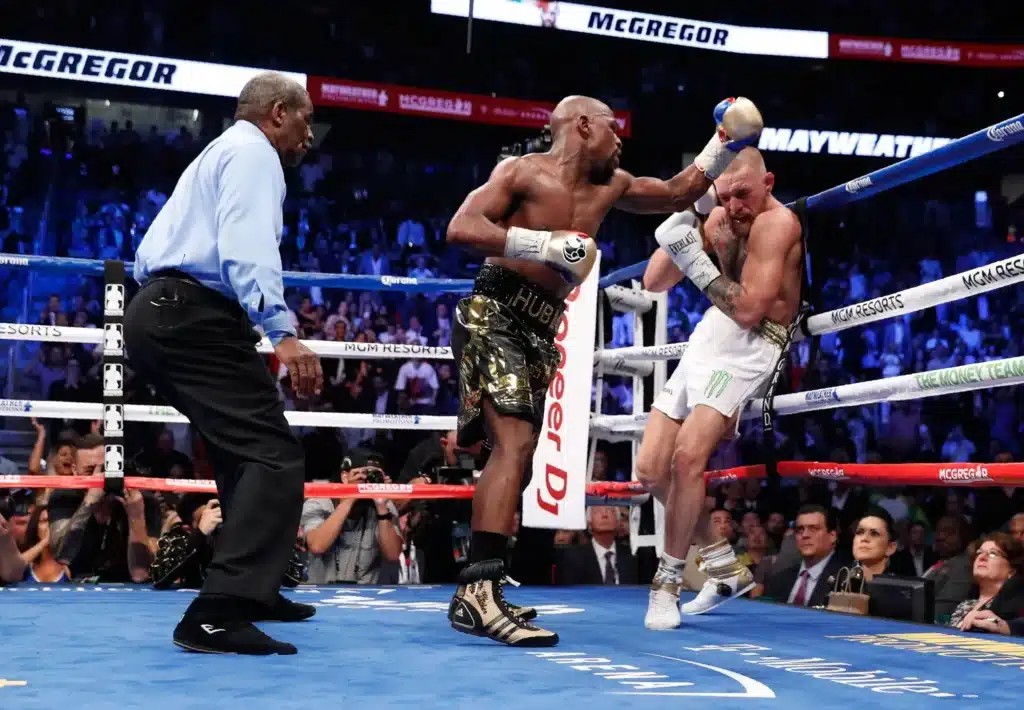
  • When Conor McGregor boxed Floyd Mayweather, he made more money in one night than he did in his entire 10-year UFC career.

  • Francis Ngannou left the UFC to box Tyson Fury and Anthony Joshua, instantly achieving generational wealth.

Every MMA fighter secretly harbors a dream: If I can display dominant boxing skills inside the Octagon (like frequently KOing opponents with flashy combinations), I can build massive commercial influence. Fans love standing brawls, and promoters love Highlight Reels—these guarantee box office success. Once they reach a certain level of fame, they have the leverage to cross over and fight in a multi-million-dollar “boxing exhibition.”

For an MMA fighter, mastering boxing isn’t just a technical upgrade; it’s a golden ticket to maximizing the commercial value of their career.

Conclusion: Boxing Doesn't Replace; It Elevates

Returning to our original question: Why is every MMA fighter learning boxing?

Because in the constantly evolving laboratory of mixed martial arts, fighters have used blood and sweat to verify one absolute truth—among all stand-up striking arts, the geometry, rhythm, defensive logic, and distance control of Western Boxing constitute the hardest Base Code to crack.

They aren’t abandoning kicks or Brazilian Jiu-Jitsu. Instead, they are using boxing’s “footwork” to optimize angles, boxing’s “defense” to survive 4oz gloves, and boxing’s “jab” to bridge the gap to their wrestling. Boxing didn’t replace any martial art in MMA; it simply became the unbreakable thread that strings the scattered pearls into a lethal necklace.

Next time you watch the UFC or ONE Championship, don’t just focus on who kicks harder or who is grappling on the mat. Try paying attention to their lead foot, their head movement, and the very first jab they throw. Once you understand the details behind these exchanges, you’ll realize that what is happening inside the Octagon is actually a brutally elegant game of physical chess.

🥊 Find Your Personal Combat Code

After reading this breakdown, do you want to personally experience the ultimate footwork and evasive rhythm of traditional Boxing?

Whether you are an MMA fanatic looking to sharpen your stand-up striking, or a complete beginner who just wants to learn the Sweet Science while burning fat and relieving stress, Chan Ka Wa Boxing can tailor the perfect training for you. We reject cookie-cutter group classes. Our former HK Team coaching staff will personally fix every micro-detail of your form.

💡 Training Investment Must-Read: Want to maximize your technical growth and progress speed? Check this out: 👉 [Boxing Guide: Personal Training (PT) vs. Group Classes – Which is Better? Cost & Effectiveness Explained

👉 WhatsApp us now to book your first 1-on-1 Professional Boxing Trial Class with a former HK Team Coach, and let our scientific Soviet system break your technical bottlenecks!