
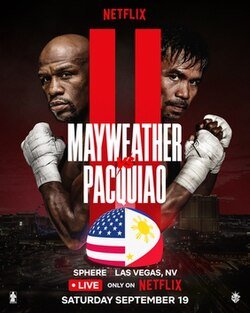
The Sugar and Poison of the Fight of the Century: Deconstructing the Ring Philosophy of Mayweather vs. Pacquiao
SOUCE: WIKIPEADIA
Boxing fans waited five full years. On the night of May 2, 2015, the eyes of the entire world were focused on the MGM Grand in Las Vegas. Floyd Mayweather Jr. squared off against Manny Pacquiao in what was dubbed the “Fight of the Century.” The bout ultimately concluded with Mayweather winning via Unanimous Decision, with the three judges scoring it 118–110, 116–112, and 116–112.
However, for the casual “one-day boxing fans” who were drawn in by the massive hype, their first reaction after the final bell was usually: “Wait, that’s it? Floyd just ran away and hugged him the whole time. How did he win?”
As a boxing analyst, if all you saw was “running,” you are completely missing the forest for the trees. Readers don’t just want to know who won; they want to know why and how they won. Today, we are going to use a technical lens, commercial logic, and ring psychology to break down this $400+ million gamble of the century.
The Struggle Outside the Ring: Why Did This Fight Take Five Years?
Before we break down the techniques, we must first understand the commercial ecosystem of boxing. The reason this fight was delayed for so long wasn’t simply because one fighter was “scared” of the other. It was due to massive political and commercial tugs-of-war. Boxing is never just two men punching each other; it is a high-stakes game of chess between massive corporate mountains.
The Gridlock of Promoters and Broadcasting Rights: Pacquiao belonged to Top Rank (under legendary promoter Bob Arum). Mayweather was also originally a Top Rank fighter but later split to form Mayweather Promotions, backed by the mysterious and powerful manager Al Haymon. To complicate things further, Pacquiao had an exclusive broadcasting contract with HBO, while Mayweather had signed a record-breaking deal with Showtime. Getting two rival networks to co-produce a Pay-Per-View (PPV)—from revenue splits to production teams and announcers—was as difficult as negotiating a UN peace treaty.
The USADA Olympic-Style Blood Testing Dispute: During their first negotiations in 2009-2010, the Mayweather camp demanded strict, unannounced random blood and urine testing, subtly implying that Manny’s stamina was unnaturally superhuman. Pacquiao’s camp refused, claiming that drawing blood close to the fight would weaken him. Negotiations collapsed, and the ensuing PR war froze their relationship.
The Ego Battle of the Purse Split: Floyd always insisted he was the “A-side” (the bigger commercial draw) and demanded the lion’s share. When they finally struck a deal in 2015, Floyd took a 60% split, while Manny took 40%. From this single fight, Floyd walked away with over $250 million, and Manny secured roughly $150 million.
Camp Trash Talk: Manny’s trainer, Freddie Roach, publicly mocked Floyd for being a “coward” who cherry-picked opponents. Floyd Sr. fired back, calling Manny a “fool with a defense full of holes.” This five-year saga of bad blood successfully packaged the fight as an epic battle of “Good vs. Evil” and “The Offensive Maniac vs. The Defensive Master.”
Technical Breakdown: How Did Mayweather "Lock Down" Pacquiao?
Let’s get straight to the point. Why did Manny Pacquiao seem completely unable to unleash his usual whirlwind offense that night? Where did his signature multi-angle combinations go? What kind of magic did Floyd use?
1. Distance Control and "Textbook" Footwork
Pacquiao’s ultimate weapon is his rapid in-and-out movement to deliver dense combinations. But Mayweather’s perception of distance is strictly alien-level.
Floyd’s strategy that night was crystal clear: always stay exactly a half-step outside of Pacquiao’s striking range. Whenever Manny prepared to push off and attack, Floyd would either spear him in the chest with a stiff jab to disrupt his balance or immediately retreat laterally. Floyd wasn’t just backing up blindly; his lateral movement constantly guided Manny toward the ropes. By the time Manny managed to close the distance, Floyd had already executed a crisp pivot to slide out the side door, making it impossible for Manny to fluidly chain more than three punches together.
Extended Reading: Want to develop Mayweather’s god-tier sense of distance and evasive footwork? You need high-quality dynamic pad work! Read this 👉 [Boxing Padwork Guide] Just for Stress Relief? A Former HK Team Coach Reveals 5 True Benefits & Beginner Mistakes
2. Cracking the Southpaw: Stepping Outside
Traditionally, in an Orthodox (Floyd) vs. Southpaw (Manny) matchup, the most crucial tactical battle is fighting for the “outside lead foot” position. Whoever can place their lead foot on the outside of their opponent’s lead foot gains a clear trajectory for their rear power hand while simultaneously moving away from the opponent’s rear hand.
That night, Floyd constantly stepped to his right, ensuring his left foot was always planted on the outside of Manny’s right foot. This tiny piece of ring geometry effectively sealed off Pacquiao’s deadliest weapon: his straight left hand.
3. The Magic of the Jab to the Body
Many people failed to notice that one of Floyd’s most frequently used and highly effective weapons that night was the jab to Manny’s midsection. This tactic served two massive purposes: First, it disrupted Manny’s breathing rhythm and drained his stamina. Second, it forced Manny to lower his guard. The moment Manny dropped his hands to protect his body, Floyd’s right cross had an open lane to the head.
4. Targeted Defense and the Clinching Tactic
Everyone expected Floyd to utilize his signature Philly Shell (Shoulder Roll) defense. However, using the Shoulder Roll against a southpaw is incredibly risky, as the opponent’s straight left can easily bypass the shoulder and land in the blind spot.
Floyd adjusted his defensive posture for this fight: he kept a high guard with his right hand glued tightly to his face specifically to catch Manny’s left crosses. Whenever Manny successfully breached the distance and got to the inside pocket, Floyd absolutely refused to engage in a firefight. Instead, he decisively initiated a clinch. He tied Manny up, waited for the referee to separate them, and then reset to his favored mid-to-long range. This tactic chopped the fight up into tiny pieces, preventing Manny from ever establishing an offensive rhythm.
Mayweather vs. Pacquiao: CompuBox Analysis
Numbers don’t lie. According to CompuBox statistics, Manny landed only 81 punches the entire fight (a dismal 19% connect rate), and his total punches thrown (429) were actually 6 fewer than Floyd’s (435). The “Asian Destroyer,” famous for his terrifying offensive volume, was reduced to throwing single shots. Meanwhile, Floyd landed an incredible 48% of his power punches, completely dominating the scorecards.
Pacquiao's Hidden Undercurrent: Concealed Injuries and Tactical Stubbornness
To be fair, Pacquiao was not at 100% that night. After the fight, his camp confirmed he had a torn right rotator cuff. They had even requested a legal Toradol (painkiller) injection from the Nevada State Athletic Commission before the fight, which was denied.
A compromised right shoulder meant Manny couldn’t throw a threatening right hook to keep Floyd honest. Once Floyd realized in the early rounds that Manny’s right hand posed no threat, his defensive pressure plummeted. This allowed Floyd to move to his right with absolute impunity to avoid Manny’s left hand.
However, aside from the injury, Pacquiao’s camp (specifically coach Freddie Roach) showed fatal stubbornness in their tactical adjustments. When Floyd successfully used the clinch to break the tempo, Manny lacked the inside fighting techniques required to break free and counter. He could only look helplessly at the referee to separate them. Having no Plan B was the fatal flaw that cost Manny the decision.
An Unpopular Opinion: Did Floyd Really Just "Run" to Win?
Many fans cursed Floyd for being a “runner,” claiming he ruined the entertainment value of boxing and ripped off fans who paid top dollar for the PPV. But as someone who truly understands boxing, I have to say this: Floyd put on an absolute masterclass in defensive counter-punching that night.
The highest echelon of boxing is “Hit and don’t get hit”—it is not a street brawl. Manny stepped into the ring wielding weapons of mass destruction, but Floyd used his Ring IQ, geometric spatial awareness, and ultimate exploitation of the rules to dismantle those weapons one by one.
If you wanted to see a bloody, rock-’em-sock-’em slugfest, this fight definitely disappointed you. But if you wanted to see how a genius uses pure technique to render another genius completely helpless, these 12 rounds are a defensive textbook worth studying frame by frame.
Extended Reading: Speaking of crushing opponents with superior Ring IQ, there was another legendary masterclass recently! Read this 👉 [Boxing Analysis] Crawford vs Spence: A Masterclass in Tactical Domination Explained
Conclusion: The End of an Era
Mayweather vs. Pacquiao wasn’t just a fight; it symbolized the curtain closing on a golden era. They represented two extremes: Pacquiao was the grassroots hero, fighting for his country, swinging with reckless abandon—a warrior draped in heroism. Mayweather was the undefeated emperor who deeply understood the rules of the commercial game, possessed a watertight defense, and calculated every risk to the decimal.
Ultimately, the ring ruthlessly proved one thing: in the world of elite boxing, a cool head and precise calculation will often defeat pure passion and bloodlust. That is the cruelty of boxing, and that is also its ultimate charm.
🥊 Find Your Personal Combat Style
After reading this breakdown, are you itching to personally experience the ultimate footwork and defensive aesthetics of the “Hit and don’t get hit” philosophy?
Whether you want to unleash explosive combinations like Manny or build a watertight defense like Floyd, the coaching team at Chan Ka Wa Boxing, led by a former Olympic representative, can tailor the perfect technical training for you.
(Still deciding how to start? Read our beginner’s guide to avoid commercial traps 👉 [Boxing Guide: Personal Training (PT) vs. Group Classes – Which is Better? Cost & Effectiveness Explained

[Boxing Analysis] Did Mayweather Just Run? The Tactical Truth Behind Mayweather vs Pacquiao
Many fans claim Floyd Mayweather just ran and hugged during the Fight of the Century. A former Olympic boxer breaks down the tactical masterclass that neutralized Manny Pacquiao.
![[Boxing Analysis] Crawford vs Spence: A Masterclass in Tactical Domination Explained](https://chankawaboxing.com/wp-content/uploads/2026/07/Errol-Spence-Jr.-left-and-Terence-Crawford-300x200.webp)
[Boxing Analysis] Crawford vs Spence: A Masterclass in Tactical Domination Explained for Beginners!
Wondering how Terence Crawford dominated Errol Spence Jr.? A former HK Olympic boxer breaks down the historic fight, from the jab battle and distance control to lethal counter-punching.
Why Are Top UFC Fighters Obsessed with Boxing? 5 Reasons
Notice how UFC fighters are utilizing pure boxing techniques? A former HK Team coach breaks down why MMA striking is returning to traditional boxing, from 4oz glove defense and footwork to wrestling transitions!

[Boxing Beginner’s Guide] A Must-Read for Newbies: Self-Taught boxing or Gym? The Golden Steps from Zero to the Ring
Is self-taught boxing a bad idea? A former HK Boxing Team coach breaks down everything beginners need to know, from gym prices to essential equipment.

[HK Team Coach] Does Kids Boxing Make Them Violent? 5 True Benefits
Worried that kids boxing promotes violence? A former HK Boxing Team coach explains the true benefits of children’s boxing classes in Hong Kong, from building laser focus and confidence to relieving academic stress safely.
Canelo vs. Bivol Breakdown: Why the Mexican Superstar Really Lost
The In-Ring Truth: Technical Breakdown — How the Soviet-Style Defense Neutralized the Mexican Superstar Many people only look at whether “heavy punches land,” but to