
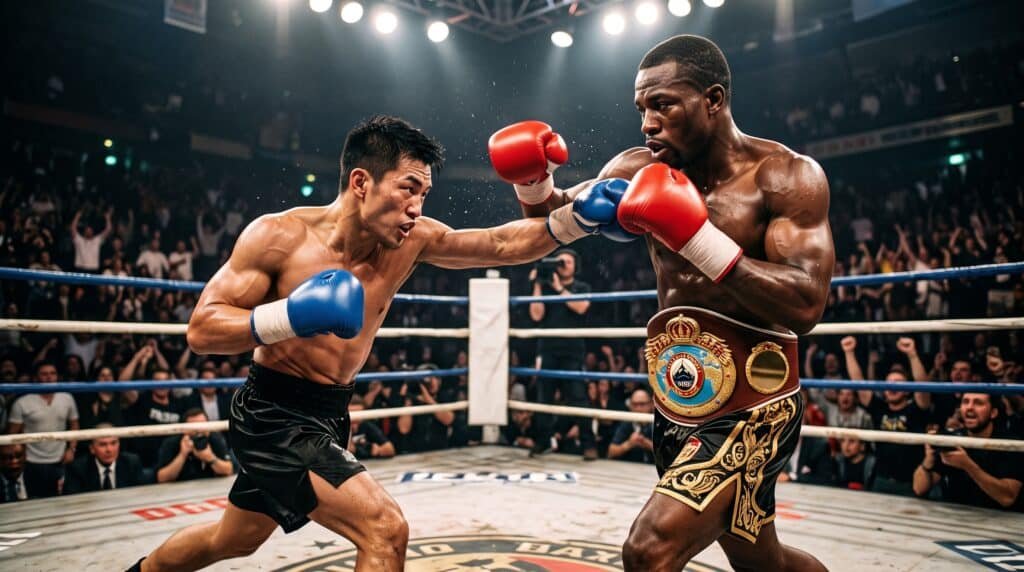

【Coach's Column】Former Olympian Breaks Down the 4 Decisive Gaps Between Elite Boxers vs Contenders! The Secrets of Ring IQ and Footwork
In the brutal arena of professional boxing, anyone who breaks into the world’s top 50 is undeniably a one-in-a-thousand Contender. They possess phenomenal stamina, devastating knockout power, and muscle memory forged through thousands of hours of grinding. However, when we shift our focus to the very top of the pyramid—those Pound-for-Pound (P4P) Elite Champions—you quickly realize that speed and power stopped being the deciding factors a long time ago.
As a former Hong Kong Olympic boxing representative who has been coaching for 8 years since retiring, I am constantly asked the same question by students and fight fans: “Coach, that challenger clearly has faster hands and bigger muscles than the champion. Why can’t he land a single clean shot?”
The answer is simple: Good contenders fight with their bodies and technique; elite champions fight with space, time, and psychology.
Using my practical perspective as a former Olympian, I am going to deconstruct the technical breakdowns, the Ring IQ, the mental resilience under pressure, and the commercial leverage of the four major organizations. This is the ultimate breakdown of that invisible, nearly insurmountable wall separating a mere contender from a true world champion.
▍I. The Micro-World of Technique: The Geometry of Distance Control and Footwork
Casual fans watch a boxing match to see who punches harder; experts watch the feet.
1. The Magic of Distance Control: Dancing on the Edge of a Knife
A good contender knows the difference between a “safe distance” and a “striking distance,” using simple glides to move in and out. An elite champion’s distance control, however, is a game of micro-management precise to the inch.
Take Japan’s “Monster” Naoya Inoue or defensive grandmaster Floyd Mayweather. When an opponent throws a punch, they don’t take a massive step back. Instead, they retreat just half a step, execute a subtle pull, or roll their shoulder. That fraction of a second and those mere inches allow the opponent’s knuckles to harmlessly graze the tip of their nose.
The Contender’s Defense: Takes a large step back. While they successfully evade the attack, they completely forfeit their position to counter.
The Elite Defense: Stays right on the absolute edge of the opponent’s striking radius, making the opponent miss and lose their center of gravity, then fires a lethal counter-punch within 0.1 seconds.
💡 Advanced Counter-Punching: Want to know how to develop this precise micro-distance control and intercepting ability? Check this out: 👉 【Boxing Padwork】Just for Stress Relief? Former Olympian Breaks Down 5 Benefits and Rookie Mistakes
▍II. Ring IQ: Downloading Data and Setting Traps
Boxing is a high-speed, violently executed chess match. Stamina will fade, and speed will decline, but Ring IQ is the ultimate factor determining how long a fighter can rule a weight class.
1. The Ability to “Download Data”
Current P4P king Terence Crawford is the absolute epitome of this. For the first two or three rounds of a fight, Crawford usually looks quite conservative. He isn’t scared; he is “downloading data.”
He will deliberately throw probing jabs just to observe whether the opponent instinctively slips left, slips right, or parries. Once he maps out the opponent’s neurological defensive reflexes, the fight is practically over.
The Contender: Steps into the ring with a flawless Plan A and stubbornly executes it blindly.
The Elite Champion: Steps into the ring with Plan A, completely reads your Plan B by the end of round one, and custom-builds a death trap for you by round three.
2. Setting Traps
Combinations are never just blind flurries of punches. When professional coaches break down technique, we always talk about feints.
A contender throws a 1-2 (jab-cross) with the sole intention of knocking the opponent out with that exact combination. An elite champion might throw a jab without any intention of landing it; they throw it specifically to force the opponent to raise a high guard, thereby exposing a gap in the ribs, only to immediately follow up with a lethal liver shot. They aren’t punching where you are right now; they are punching where you are about to move.
💡 Classic Ring Tactics Relived: Want to see how god-tier Ring IQ dominates a fight? Check this out: 👉 【Boxing Analysis】The Monster vs. The Flash! A Former Olympian Breaks Down Inoue vs. Donaire
▍III. Bouncing Back from the Abyss: Resilience and Adaptability When Plan A Fails
Mike Tyson famously said, “Everyone has a plan until they get punched in the face.” The exact moment that separates a contender from an elite champion usually occurs in the late stages of a fight (Rounds 8 through 12)—the phase appropriately named the Championship Rounds.
1. On-the-Fly Adaptability
When a power-reliant contender realizes their opponent possesses an iron chin and refuses to go down, they often panic. Their technique gets sloppy, and their stamina burns out rapidly.
If an elite champion realizes Plan A (e.g., chasing a KO) isn’t working, they can spend the one-minute rest period listening to their corner, instantly flipping their mindset to Plan B (e.g., fighting on the outside to secure a points victory). They are never hijacked by their own ego. Winning ugly is always better than losing the fight.
2. Recovery from Devastating Blows
Look back at the first fight between Tyson Fury and Deontay Wilder. In the 12th round, Fury was caught by Wilder’s nuclear right hand and fell flat on his back, eyes rolled back. 99% of contenders would have seen their careers end right there on the canvas. Yet, at the referee’s count of 9, Fury sat up like the Undertaker and actually battered Wilder for the remainder of the round.
This is the hallmark of an elite champion: terrifying psychological resilience and recovery capacity. They do not crumble in the face of absolute adversity; instead, the abyss triggers a deeper, primal instinct for survival and destruction.
💡 Forge an Iron Mindset: How do you face fear and failure in the ring? Check this out: 👉 【Champion Mindset】Former Olympian Explains: Want to Win? The Mental Toughness and Resilience Required for the Ring
▍IV. The Out-of-Ring Grapple: Commercial Value and Political Leverage
A top-tier boxer cannot afford to only know how to box, because 50% of modern boxing is fought outside the ropes. Understanding how promotional companies and television networks operate is the only way to truly grasp the ecosystem of professional boxing.
Professional boxing is governed by four major sanctioning bodies (WBA, WBC, IBF, WBO), alongside promotional giants like Matchroom Boxing, Top Rank, and broadcasting platforms like DAZN and ESPN.
The Contender: Usually acts as a pawn for the promotional companies. They are thrown into grueling, high-risk fights for relatively meager purses, often serving as “Gatekeepers”—stepping stones used to test rising, highly-promoted stars.
The Elite Champion: Knows how to transform themselves into the “A-Side” and a walking cash cow.
Fighters like Canelo Alvarez or Floyd Mayweather transcended the confinement of championship belts. They don’t look to the sanctioning bodies for approval; the bodies look to them. They know exactly how to leverage competition between promotional companies to skyrocket their own value, maintaining absolute control at the negotiating table (dictating the fight location, glove brands, and even catchweight limits).
▍Crossing That Invisible Wall
If you possess blazing hand speed, heavy knockout power, and can fluently execute various combinations, you are undeniably a fearsome contender. You can tear through standard competition. But if you want to become a generational Elite Champion, you need vastly more than physical tools:
You need the Ring IQ to look into your opponent’s soul and the counter-punching ability to predict their next move.
You need spatial awareness and footwork precise to the millimeter so the opponent can never target your center of gravity.
You need the iron will to climb back up from the absolute abyss.
You need high-level commercial intelligence to build yourself into an irreplaceable super-brand in a sea of promotional sharks.
For those who truly understand boxing, the most captivating moment is never the final knockout blow itself. It is the six rounds of meticulously laid traps, the mastery of distance, and the complete psychological dismantling of the opponent that the champion executed before that final punch was ever thrown.
This is exactly why boxing is called the “Sweet Science,” and it is the ultimate peak that every fighter spends their entire life trying to climb.
🥊 Ready to Elevate Your Ring IQ?
Tired of being a “heavy bag hero” who only knows how to throw dead weight? Want to learn genuine footwork and the art of counter-punching?
Chan Ka Wa Boxing is personally led by a former Hong Kong Olympic representative. I hold nothing back, passing down 5 years of intense ring experience and 8 years of coaching essence to you. We reject mindless brawling; we teach you how to box with your brain!

【Boxing News】Youth Olympic Boxing Decoded! HK Prospect Chan Yik Kan Heads to Africa
How brutal is Youth Olympic Boxing? A former Hong Kong Olympic representative breaks down the U19 World Boxing Championships and previews CKW Boxing prospect Chan Yik Kan’s upcoming expedition to Africa.

【Boxing Analysis】Why Did Cuban Boxing Decline? A Former Olympian Breaks Down 4 Brutal Truths
Once the untouchable gods of Olympic boxing, why has Cuba fallen from grace? A former Hong Kong Olympic representative analyzes the 4 brutal truths behind the decline of Cuban boxing, from scoring system changes to the rise of Central Asian fighters.

【Coach’s Column】Is Boxing Violent? Former Olympian Explains 3 Reasons Why Boxing is the Best “Antidote” for SEN Children!
Many parents think boxing is violent, but for SEN children (ADHD, Autism), it’s a miracle sport for training focus and emotional control! A former Hong Kong Olympic representative explains how padwork, footwork, and discipline rebuild confidence and coordination in kids with Special Educational Needs.
【Boxing Science】How to KO in Boxing? Former Olympian Unlocks 3 Essential Rules
Want to know how to KO in boxing? A former Olympic coach breaks down the science of knockouts, the kinetic chain, timing, and why headhunting gets you KO’d.

【Coach’s Column】Want to Learn Boxing But Afraid to Take the First Step? A Former Olympian Breaks Down 4 Mental Barriers and Prep Tips for Boxing Beginners
Want to learn boxing but worried about your fitness, coordination, or getting hurt? A former Hong Kong Olympic coach breaks down the 4 biggest mental barriers for boxing beginners and explains how to take your first step safely.

【Combat Mindset】Closing Your Eyes in Sparring? 4 Steps to Overcome Ring Fear
Terrified of your first boxing sparring session? A former Hong Kong Olympic representative explains how to stop flinching, control your vision, and use condition sparring to overcome ring fear and build real Ring IQ.