
【Coach's Column】Every Inch Counts in the Ring: Are Hong Kong Boxing Gyms Too Small to Train Footwork? A Former Olympian Breaks Down Space and the 3 Truths of "Russian Boxing"

香港拳館空間細,真係練唔到好技術?前香港奧運代表親自拆解香港、歐美與中台拳館嘅生態差異。教你點樣利用香港「寸土必爭」嘅細空間,逼出頂級「俄式拳擊 (Russian Style)」嘅微距控制同步法!新手學拳必讀。

If you’ve watched Rocky or recent behind-the-scenes documentaries on DAZN, your mental image of a boxing gym probably looks like this: a high-ceilinged industrial warehouse, dozens of heavy bags hanging like a forest, two full-sized (20×20 ft) rings side-by-side, and endless open floor space for fighters to skip rope and shadowbox.

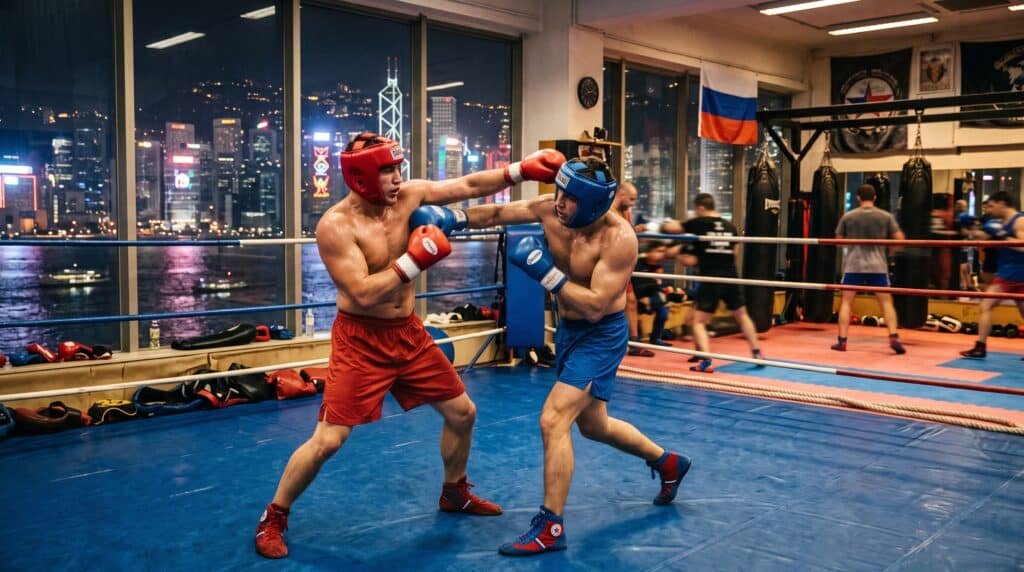
But when you step into an industrial building in Kwun Tong or Mong Kok and push open the fire door of a boxing gym, the sight that greets you is usually quite different: exquisite, compact, where the distance between the heavy bag area and the ring might only be a few steps.

As a former Hong Kong Olympic boxing representative with an 8-year coaching career and 5 solid years of experiencing high-intensity competition while teaching, I have traveled the world for training camps and seen countless gyms. Many beginners and even students who have trained for a while ask me the same question: “Coach, Hong Kong gyms are so small, can you really learn good footwork and technique here?”

Everyone, boxing has never been a sport about “space”; it is an art of “distance control.” Especially since my teaching system is built on the “Soviet/Russian Boxing Style,” which is renowned for its footwork and Ring IQ. Today, using the analytical eye of a former HK team member, I will compare the spatial and ecological differences between boxing gyms in Hong Kong, the US, the UK, Mainland China, and Taiwan. I’ll tell you why learning to box in Hong Kong’s “small spaces” is actually a hidden advantage that forces out ultimate technique.

▍I. Boxing Geography: Spatial and Commercial Logic of Gyms Around the World

To understand a region’s boxing style, look at what their gyms look like. Behind the aesthetics lies brutal commercial real estate logic, which ultimately dictates a fighter’s rules of survival.

  • The US and UK: Heavy Industrial Vibe and “Garage Culture” In the US (especially California and Philly) and the UK, boxing gyms are usually located in cheap, marginal industrial zones. Spaces spanning 3,000 to 5,000 square feet are the norm. Technical Impact: Massive space breeds ultimate outside boxing. Fighters have infinite room to retreat and circle. Ecology: The “Law of the Jungle” prevails here. One coach might simultaneously watch thirty kids hit the bags; if you don’t possess absolute, undeniable talent, the coach simply won’t waste time holding pads for you.

  • Mainland China and Taiwan: Capital Injection and Comprehensive Development With the recent boom in combat sports in Mainland China and Taiwan, many gyms in tier-one and tier-two cities are backed by massive capital. They boast over 10,000 square feet, combining Strength & Conditioning (S&C) zones, juice bars, and even physical therapy. Technical Impact: Perfect equipment allows for the most scientific S&C. Full-size Olympic rings help amateurs adapt to competition distances early. Ecology: Highly commercialized, focusing heavily on the customer experience and Instagram check-in culture. The hardware is flawless, but it sometimes lacks the “hardcore” blood-and-sweat atmosphere of traditional gyms.

  • Hong Kong: The “Art of Compression” in Industrial Buildings Back in Hong Kong, most boxing gyms range from 1,000 to 2,500 square feet, classifying them as “micro-gyms” by international standards. The crushing pressure of astronomical rent forces gym owners to maximize every single square inch. Technical Impact: A small space means you have “nowhere to retreat.” This environment perfectly aligns with modern high-level technical demands—you must learn to survive in extreme close quarters. Ecology: High density creates an incredibly high coach-to-student ratio. In Hong Kong, you absolutely cannot hide in a corner and slack off. This is the biggest advantage of high-quality HK gym coaching.

▍II. Technical Breakdown: How Small Spaces Forge Elite "Russian Footwork"

Many laymen hold a massive misconception: they think without a large space, you can’t train footwork.

In the ring, true despair isn’t your opponent running faster than you; it’s your opponent standing right in front of you, you can’t hit them, and the moment they reach out, they light you up. The Russian Style we advocate heavily emphasizes the Pendulum Step, precise distance, and geometric angles. Hong Kong’s compact spaces provide the strictest possible training grounds for this exact style:

1. The Zenith of Micro-Distance Control

The Russian style preaches “Hit and don’t get hit,” but it absolutely does not tell you to run. In a narrow heavy bag area, you are only an arm’s reach away from the person next to you. This environment forces you to learn “half-step” movements. You can’t rely on massive leaps to evade attacks; you must learn to use microscopic weight transfers and half-step pull-backs to make your opponent miss, utilizing the pendulum’s rebound to fire an instantaneous counter-punch. In a small HK gym, you are polishing this millimeter-level distance control every single day.

2. Visual Obscurement and Angles & Pivoting

When space is limited, you cannot rely on “hit and run” tactics forever. The sharpest tool in Russian boxing is using the lead hand to disrupt the opponent’s vision, then pivoting on the front foot to cut directly into their blind spot. When the ring or training space is small and you are backed into the edge, pivoting is your only weapon for escape and counter-kills. Small spaces force you to drill the Pivot until it becomes pure muscle memory.

3. Active Defense and High-Pressure Rhythm

With nowhere to retreat, you must learn to “Stand your ground.” The Russian style teaches you to maintain a High Guard, using parries and micro head movement to neutralize attacks, and immediately returning fire with combinations. This “telephone booth” style of brawling drastically elevates a fighter’s psychological resilience and composure under intense pressure.

💡 Footwork and Counter-Punching Essential Reading: You’ve mastered micro-distance control and pivots in tight spaces, but how do you execute them in dynamic training? You need highly tactical padwork! Check this out: 👉 【Boxing Padwork】Just for Stress Relief? Former Olympian Breaks Down 5 Benefits and Rookie Mistakes

▍III. Why is HK's Gym Ecology Better for Beginners and Advanced Fans?

If what you want to learn is the true Sweet Science—and not just Cardio Boxing for a sweaty selfie—Hong Kong’s gym ecology actually possesses irreplaceable advantages.

1. Inescapable “High Attention”

In a massive US gym, you could hit a heavy bag with the wrong form for a month and no one would care. But in a 1,500 sq ft Hong Kong gym, the coach’s eyes cover the entire floor. If your center of gravity is off or your right hand drops, I will catch it in one second and yell to stop you on the spot. This high-frequency, intensive technical correction is the absolute key to building a solid foundation for beginners.

💡 Beginner’s Guide to Avoiding Pitfalls: Want to build a solid foundation at a high-quality gym? Should you figure it out yourself in a large group class, or hire a pro coach to fix your posture? Check this out: 👉 【Boxing Guide】PT vs Group Class: Which is Better? HK 1-on-1 Boxing Costs and Benefits

2. Refined Systematic Teaching

Because we cannot fit 50 people in a class simultaneously, high-quality gyms in Hong Kong mostly adopt a small-class format. This scale allows me to precisely control the training rhythm. From dynamic warm-ups and Russian footwork drills to heavy bag mechanics and Condition Sparring, every single segment is tightly interlocked.

3. Tight-Knit Ring Brotherhood

Boxing is inherently a solitary sport, but in Hong Kong’s gyms, the compact space fosters frequent communication among gym-mates. During sparring, everyone gathers around the ring to help you spot openings and call out tactics; senior members proactively guide the rookies. This kind of camaraderie is something you will never find in a cold, massive chain gym.

Looking back at boxing history, the Catskill gym where legendary coach Cus D’Amato trained Mike Tyson was nothing more than a rundown attic. The size of the venue never dictates the hardness of your punch.

For those wanting to start learning boxing, do not be misled by “square footage.” What you should be looking at is: Does the coach have real, practical ring experience? Do they have a scientific, battle-tested tactical system (like Russian boxing) to teach you?

In Hong Kong’s “every inch counts” spaces, we have actually forged more nuanced distance control, tougher psychological resilience, and the Ring IQ to box with our brains. The next time you walk into a boxing gym, focus entirely on the center of gravity beneath your feet, because the true size of the ring ultimately depends on your mindset and your footwork.

🥊 Want to Personally Experience the Power of “Russian Style” Footwork?

Don’t let the size of a venue limit your technique! Chan Ka Wa Boxing is personally led by a former Hong Kong Olympic representative, holding nothing back in passing down 5 years of intense ring combat and 8 years of coaching essence, combined with an authentic Russian boxing system.

👉 Click Here / WhatsApp Us Now to book your 【1-on-1 Pro Boxing Trial with a Former Olympian】, and learn to box with your brain while experiencing the true art of footwork and distance control!