
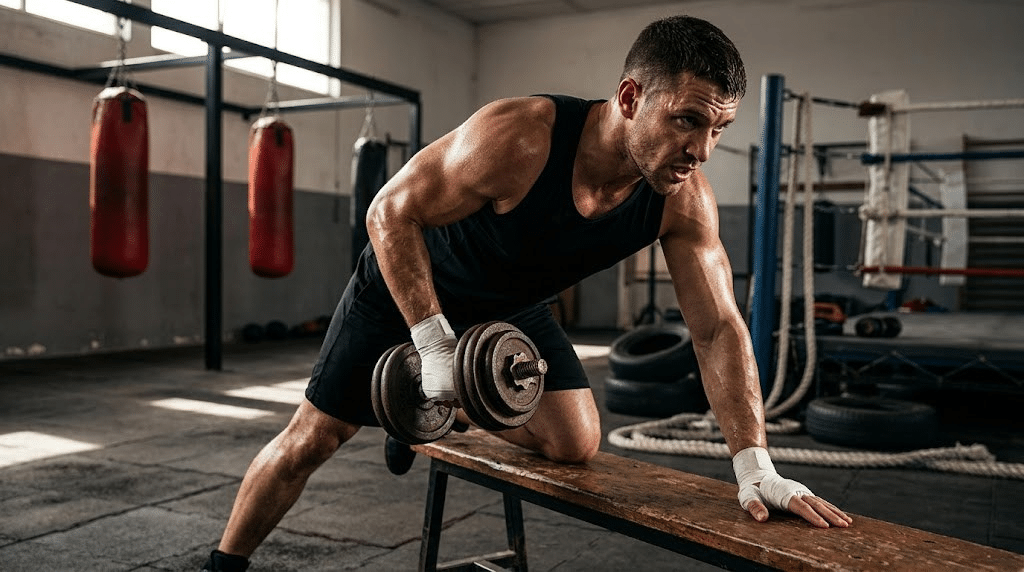

【Coach's Column】Boxing Weight Training: Does Lifting Make You Slower? Former Olympian Unlocks the Ultimate Guide to Explosive Power
“Coach, I want to punch harder, should I start lifting weights at the gym?” “Absolutely not! Lifting weights builds bulky muscles that will make you slower. Speed is everything in boxing!”
If you’ve heard this exchange in a boxing gym, you’ve encountered the oldest and most misleading myth in the boxing world.
As a former Hong Kong boxing representative and a current full-time coach, I heard my fair share of these old-school myths during my national team training days. However, after engaging with world-class fighters abroad and diving into modern sports science, I can tell you this with absolute honesty: The saying “lifting weights makes you slow” only applies if you train like a bodybuilder.
In modern elite professional boxing and MMA, from Canelo Álvarez to Naoya Inoue, every top fighter relies on a rigorous Strength & Conditioning (S&C) team. When you’re in the ring with a physical monster—when you hit them with everything you have and they don’t budge, yet their simple jab shatters your balance—you’ll realize just how crucial a solid “foundation of strength” truly is.
Weight training doesn’t make you slow. When done correctly, it is the only scientifically proven way to turn yourself into a “human cannon.” In this comprehensive guide, I will use my practical ring experience and sports science to break down exactly how boxers should approach weight training, complete with a practical workout schedule.
▍Busting the Myth: Why "Bodybuilding" Destroys a Boxer
Many beginners walk into a gym and immediately adopt a bodybuilder’s routine they found online: Chest Day today, Back Day tomorrow, aiming for 8-12 reps per set to achieve a “pump” and muscle hypertrophy.
This training method is slow poison for a boxer.
Boxing is a neurological sport that demands total body coordination. When you isolate specific muscles using bodybuilding techniques (like endlessly doing bicep curls), you are merely adding “dead weight” to your body. Every extra kilogram of useless, dead muscle in the ring consumes extra oxygen, draining your stamina rapidly. More importantly, isolation exercises fail to teach your nervous system how to connect and coordinate your entire body to generate force.
The Verdict: Boxers don’t go to the gym just to build muscle; they go to train movement patterns and neural transmission.
💡 Essential Reading for Beginners: Before chasing power, if you don’t have the fundamentals of your stance and punch mechanics down, all the heavy lifting in the world won’t help! Starting from scratch? Check this out: 👉 【Boxing Beginner’s Guide】Self-Taught or Gym? The Complete Guide from Zero to Sparring
▍The Physics of Power: The Science Behind a Heavy Punch
To understand the logic behind weight training for boxing, we need to revisit a fundamental physics equation:
$F = m \cdot a$
(Force = Mass $\times$ Acceleration)
In boxing, your body weight (Mass) is restricted by your weight class, so you can’t just bulk up endlessly. Therefore, to increase your striking impact (Force), you must increase the acceleration of your body’s movement and force generation.
Taking this a step further to the formula for explosive power:
$P = F \cdot v$
(Power = Force $\times$ Velocity)
This equation perfectly explains why boxers need weight training: You need a massive base of absolute strength (Force), which you then convert into extreme speed (Velocity) through specialized training, ultimately producing devastating explosive power (Power).
A punch is never just thrown with the arm; it relies on a complete Kinetic Chain. The power initiates from the feet pushing off the ground, transfers through the legs, multiplies via hip rotation, stabilizes through a tight core, and is finally delivered through the shoulders to the knuckles. Our weight training is designed to strengthen every single link in this chain.
▍The 3 Golden Phases of Boxing Weight Training
In the old days, our competition prep often consisted of endless push-ups and running up mountains. Today, a scientific S&C cycle is typically divided into three phases. Don’t rush into fancy movements; building the foundation is king.
Phase 1: Maximal Strength (Building the Base)
Goal: Improve the nervous system’s ability to recruit muscle fibers and build the “cannon’s base” without adding excessive muscle bulk.
Core Concept: Heavy weight, low reps, long rest.
In this phase, we focus on compound, multi-joint movements. Your goal is to lift heavier iron, training your nervous system to overcome immense resistance.
Lower Body Push: Barbell Squat, Bulgarian Split Squat. The squat is the ultimate movement for building leg drive.
Lower Body Pull: Deadlift, Romanian Deadlift (RDL). These strengthen the hamstrings and glutes—the engine of your power generation.
Upper Body Push: Barbell Bench Press, Overhead Press.
Upper Body Pull: Weighted Pull-ups, Barbell Row. Back strength is critical for boxers; it determines how fast you can snap your punches back to your face and protects your shoulders from injury.
Training Parameters: 3-5 reps per set, using 80%-90% of your 1RM, resting 3-5 minutes between sets.
Phase 2: Power & Plyometrics (The Conversion)
Goal: Convert the “absolute strength” built in Phase 1 into applicable, explosive “power” for the ring.
Core Concept: Moderate weight, maximum speed, high explosiveness.
Now that we have a strength base, we must teach the body how to release that force in 0.1 seconds. This phase introduces Plyometrics and ballistic training.
Medicine Ball Throws: The closest training to actual punching mechanics. Rotational Med Ball Toss, Overhead Slams.
Lower Body Explosiveness: Box Jumps, Trap Bar Jumps.
Upper Body Explosiveness: Clapping Push-ups, Explosive Landmine Press.
Training Parameters: Your intent must be on SPEED! 3-6 reps per set. The weight shouldn’t be too heavy (approx. 30%-50% of body weight or light med balls). The key is to exert 100% maximal velocity on every single rep.
💡 Mastering the Transfer: Want to perfectly apply that gym-built explosiveness into the ring and your footwork? You need high-quality, specialized pad work! Read more: 👉 【Boxing Padwork】Just for Stress Relief? Former Olympian Breaks Down 5 Benefits and Rookie Mistakes
Phase 3: Core & Anti-Rotation (The Transmission Hub)
Goal: Build an unbreakable transmission center to minimize force leakage.
Core Concept: Forget sit-ups; focus on resistance and anti-rotation.
Many believe training the core means doing endless sit-ups for a six-pack. Having taken my fair share of heavy body shots in the ring, I can assure you: the core’s primary functions in boxing are to “transmit force” and “absorb impact,” not to flex the spine.
Anti-Rotation: Pallof Press. When an opponent hits you, or when you miss a punch, formidable anti-rotational strength keeps your balance intact.
Anti-Extension: Ab Roller, Dead Bugs.
Explosive Rotation: Standing Landmine Rotations. This perfectly simulates the torque and hip rotation required for a powerful punch.
▍A Former Olympian's Warning: 3 Fatal Red Flags in Boxer's Weight Training
If you are planning to incorporate weight training into your regimen, you must avoid these three common pitfalls:
Training to Failure: Bodybuilders love pushing to failure to tear muscle fibers. But a boxer’s primary identity is an athlete. If you completely fry your central nervous system (CNS) in the gym, your technique will severely deteriorate when you hit the bags, pads, or spar later at the boxing gym. Weight training should leave you feeling powerful and primed, not dead and exhausted.
Neglecting Neck & Grip Strength: Boxing involves getting hit in the head. A thick, strong neck effectively absorbs the impact trauma, significantly reducing the risk of concussions (neck strengthening was mandatory in our national team camps). Additionally, superior grip strength ensures your fist is like a rock upon impact, preventing wrist injuries.
Getting Your Priorities Wrong (Boxing Comes First): Always remember: weight training is supplementary; boxing technique is the main course. If you box 4-5 days a week, lifting weights 2 days (maximum 3) is more than enough. Don’t get things backwards and sacrifice your footwork practice just to chase a heavier bench press.
(Extended Reading: How do elite fighters maximize the synergy between footwork and striking? Even top UFC fighters are obsessively cross-training in pure boxing! Find out why: 👉 【MMA Analysis】Why Do Elite UFC Fighters Train Pure Boxing? 5 Key Reasons
▍Practical Application: A 2-Day S&C Routine for Boxers
Below is a practical 2-day-a-week S&C program suitable for amateur boxers and advanced practitioners. It is highly recommended to perform this on non-boxing days, or at least 6 hours prior to your technical boxing session, to prevent fatigue from ruining your form.
Day 1: Max Strength & Anti-Rotation Focus
| Sequence | Exercise | Sets x Reps | Rest | Notes |
| A1 | Trap Bar Deadlift | 4 x 5 | 3 Min | Focus on a braced core; drive hard through the floor. |
| B1 | Barbell Bench Press | 4 x 5 | 2.5 Min | Control the descent; push up explosively. |
| B2 | Weighted Pull-ups | 4 x 5-8 | 2.5 Min | Alternate B1 and B2 (Superset). |
| C1 | Bulgarian Split Squat | 3 x 8 / leg | 90 Sec | Improves unilateral leg drive and balance. |
| D1 | Pallof Press | 3 x 10 / side | 60 Sec | Resist the rotational pull of the band. |
Day 2: Power & Dynamic Transfer Focus
| Sequence | Exercise | Sets x Reps | Rest | Notes |
| A1 | Rotational Med Ball Toss | 4 x 4 / side | 90 Sec | Simulates the hip snap of a hook; 100% velocity. |
| B1 | Box Jumps | 4 x 4 | 2 Min | Focus on jump height and landing softly. |
| C1 | Explosive Landmine Press | 3 x 6 / side | 90 Sec | Drive from the foot up to the shoulder press. |
| C2 | Barbell Row | 3 x 8 | 90 Sec | Maintain tension in the back. |
| D1 | Farmer’s Walk | 3 x 30 meters | 60 Sec | Builds extreme core rigidity and crush grip strength. |
▍Conclusion: Forging Iron into a Lethal Weapon
Boxing is known as the Sweet Science, and modern strength and conditioning is the very engine that powers this science.
Lifting weights will not make you slow. Lifting weights without a plan, direction, or periodization is what makes you slow.
Once you grasp the underlying physics and shift your focus from building muscle size to optimizing force transmission and velocity, every punch you throw in the ring will carry the devastating impact needed to dismantle your opponent.
Ready to drop your fear of the weight room? Next time you step into the gym, stop bench pressing to failure. Instead, grab a medicine ball, slam it against the wall with violent intent, and feel that ultimate explosive power transfer from your toes right through to your knuckles! See you in the ring.
💡 Maximize Your Training Investment: Why is hiring a specialized Personal Trainer (PT) the best way to seamlessly blend S&C with boxing technique?

【Boxing News】Youth Olympic Boxing Decoded! HK Prospect Chan Yik Kan Heads to Africa
How brutal is Youth Olympic Boxing? A former Hong Kong Olympic representative breaks down the U19 World Boxing Championships and previews CKW Boxing prospect Chan Yik Kan’s upcoming expedition to Africa.

【Boxing Analysis】Why Did Cuban Boxing Decline? A Former Olympian Breaks Down 4 Brutal Truths
Once the untouchable gods of Olympic boxing, why has Cuba fallen from grace? A former Hong Kong Olympic representative analyzes the 4 brutal truths behind the decline of Cuban boxing, from scoring system changes to the rise of Central Asian fighters.

【Coach’s Column】Is Boxing Violent? Former Olympian Explains 3 Reasons Why Boxing is the Best “Antidote” for SEN Children!
Many parents think boxing is violent, but for SEN children (ADHD, Autism), it’s a miracle sport for training focus and emotional control! A former Hong Kong Olympic representative explains how padwork, footwork, and discipline rebuild confidence and coordination in kids with Special Educational Needs.

【Boxing Science】How to KO in Boxing? Former Olympian Unlocks 3 Essential Rules
Want to know how to KO in boxing? A former Olympic coach breaks down the science of knockouts, the kinetic chain, timing, and why headhunting gets you KO’d.

【Coach’s Column】Want to Learn Boxing But Afraid to Take the First Step? A Former Olympian Breaks Down 4 Mental Barriers and Prep Tips for Boxing Beginners
Want to learn boxing but worried about your fitness, coordination, or getting hurt? A former Hong Kong Olympic coach breaks down the 4 biggest mental barriers for boxing beginners and explains how to take your first step safely.

【Combat Mindset】Closing Your Eyes in Sparring? 4 Steps to Overcome Ring Fear
Terrified of your first boxing sparring session? A former Hong Kong Olympic representative explains how to stop flinching, control your vision, and use condition sparring to overcome ring fear and build real Ring IQ.