
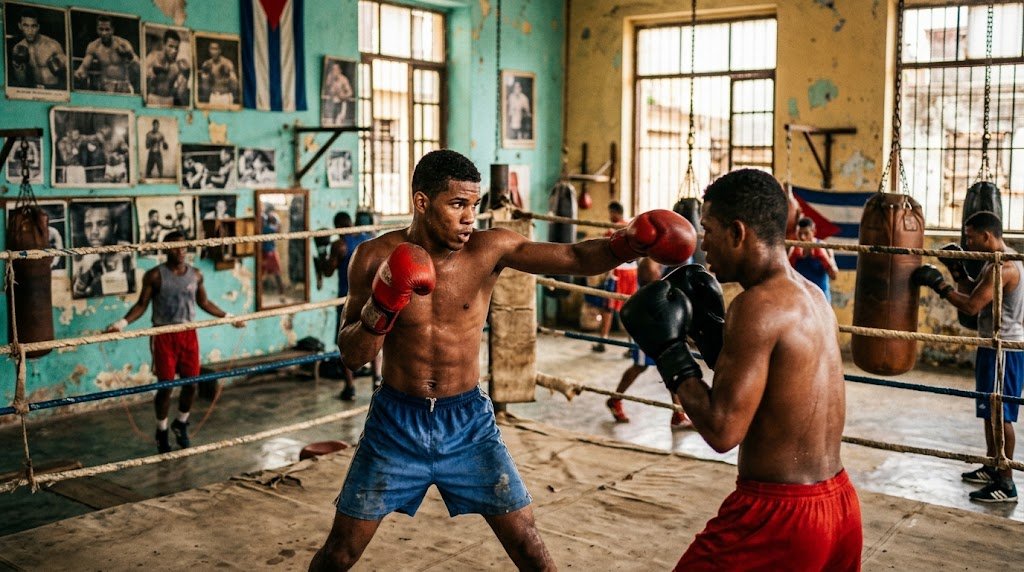

【Coach's Column】Why Did Cuban Boxing Fall from Grace? A Former Olympian Breaks Down the 4 Brutal Truths Behind the Empire's Decline
If you follow Olympic boxing or have been a boxing fan for any significant amount of time, you have definitely heard of the gold standard: “Cuban Boxing.” For decades, Cuba was a god-like presence in the Olympics and World Amateur Championships. From legends like Teófilo Stevenson and Félix Savón to the modern era’s Guillermo Rigondeaux, Cuban fighters used their god-tier rhythm, flashy evasion, and slick counter-punching to play with amateur fighters from around the globe like toys.
However, as a former Hong Kong Olympic representative who fought in high-intensity competitions for 5 years and has coached for 5 years since retiring, I have always kept a close eye on the shifting tectonic plates of the global boxing scene. In recent years (especially the just-concluded Paris Olympics and the previous Tokyo Olympics), you will notice a brutal reality: Cuban boxing’s dominance has plummeted, while Central Asian countries like Uzbekistan and Kazakhstan have aggressively taken over as the supreme overlords of amateur boxing.
Why did a nation that treats boxing as its national sport—a country that produced countless geniuses—fall from grace in just over a decade? Today, we aren’t going to talk about superficial gossip. Using a former Olympian’s tactical eye and the perspective of modern sports science, I am going to deeply deconstruct the 4 brutal truths behind the decline of Cuban boxing.
▍I. The Massive Rule Change: When a "Points Game" Became a "Domination Match"
To understand why Cuba declined, you first need to understand why they were so overpowered in the past.
Prior to 2013, amateur boxing (AIBA/IBA) utilized “Computer Scoring.” Three judges had to press a button within the exact same second for a point to register. This system heavily favored “point-scoring” tactics. Cuban fighters were absolute masters at touching you with a long-distance jab to steal a point, and then using their spectacular footwork and head movement to escape. The entire fight was essentially a game of tag (Hit and run).
However, ever since the amateur system underwent a complete reform and adopted the professional-style “10-Point Must System,” the rules of the game were completely turned upside down.
Today’s judges don’t just count how many times you land. They heavily weigh Ring Generalship, Competitiveness, and Damage Output. If you spend the entire fight backing up, looking for counters, and surrendering the center of the ring to your opponent, the judges will score against you even if you land a couple more punches. Under modern rules, Cuba’s flashy “touch and run” style became synonymous with passive fighting.
💡 Understanding Modern Amateur Rules: In the modern ring, you can’t win just by backing up! Want to know how to build a championship mindset to dominate your opponent? Check this out: 👉 【Champion Mindset】Former Olympian Explains: Want to Win? The Mental Toughness and Resilience Required for the Ring
▍II. The Total Evolution of the Central Asian Soviet System (The Reign of Russian Boxing)
While Cuba was still intoxicated by its own rhythm and evasion, the other side of the world—Central Asia (specifically Uzbekistan and Kazakhstan)—evolved the Soviet/Russian Style to a terrifyingly lethal level.
The old-school Russian style was known for being tough and linear; but modern Central Asian fighters have perfectly combined former Soviet biomechanics (the flawless kinetic chain and pendulum step) with immense forward pressure and professional-style combinations.
A Clash of Technique: Facing the flashy retreats of a Cuban fighter, Central Asian fighters simply refuse to play the long-distance game. They use textbook footwork to cut off the ring, trapping the Cuban fighters in the corners, and then execute them with devastating hooks and body shots.
Crushing Stamina and Rhythm: The Central Asian rhythm isn’t a dance; it is a machine-like, high-frequency output. Their High Guard and relentless forward pressure make Cuban fighters—who are used to fighting at their own comfortable pace—extremely uncomfortable in the mid-to-late rounds, often leading to total physical collapse.
💡 The Power of Russian Boxing: Why can Central Asian fighters corner Cuban geniuses? The key lies in utilizing space and footwork to create blind spots! Check this out: 👉 【HK Boxing Gym Guide】Gym Too Small for Footwork? Former Olympian Explains the Spatial Mastery of “Russian Boxing”
▍III. The Wave of Defections and the Talent Gap: Unable to Keep the Golden Generation
Moving past technique, we must confront the commercial and political realities. The most direct cause of Cuban boxing’s plummeting results in recent years is a massive brain drain (Defection).
For decades, Cuba operated under a socialist system that strictly banned fighters from turning professional (they were forced to partially open up only in 2022). A Cuban hero who won Olympic gold might return home to be rewarded with an old bicycle or a meager allowance. Meanwhile, across the strait in the US, professional promotional giants (like Top Rank and PBC) were waving multi-million dollar contracts at them.
In recent years, almost all of Cuba’s top-tier geniuses have defected immediately after competing in the Olympics:
Robeisy Ramírez: (Two-time Olympic Gold Medalist, turned pro and became WBO World Champion)
Andy Cruz: (Tokyo Olympic Gold Medalist, widely considered the technical ceiling of the sport, recently defected to turn pro)
Yoenlis Feliciano Hernández: (2023 World Championship Gold Medalist, defected and abandoned the team directly during a tournament)
When all the prime, most talented A-list fighters flee to the US to fight professionally and improve their families’ lives, the Cuban national team is left relying on aging veterans (like Julio César La Cruz, who is fighting well into his thirties) to hold the line, or forcing green, unpolished youths into the ring. This severe rupture in their talent pool caused Cuba to completely lose its dominance on the global stage.
▍IV. Lagging in Sports Science and Nutrition: Old-School Grinding Can't Beat Big Data
The final point is the one that makes me sigh the most as a coach who highly values modern sports science.
In the 1970s through the 1990s, Cuba possessed the world’s most advanced state-sponsored sports development system. But after years of economic sanctions and collapse, Cuba’s sports infrastructure has severely aged. If you watch training documentaries on Cuban fighters today, they are still running up mountains on dirt roads, using rusty dumbbells from decades ago, and lacking even the most basic high-protein nutritional supplements.
In stark contrast, the rising powers of Uzbekistan, the UK, the US, and Asian powerhouses are backed by massive state machines and vast capital:
Scientific Data Monitoring: Every habitual movement of an opponent is recorded and analyzed by a dedicated data team.
Elite Strength & Conditioning (S&C): It’s no longer about blindly running 10 kilometers at 5 AM; it’s about precise, periodized explosive power training.
Perfected Nutrition and Recovery Systems: Ensuring fighters don’t lose muscle mass during weight cuts, stepping into the ring at 100% capacity.
In modern boxing, no matter how high your natural talent is, it cannot defeat a national machine armed to the teeth with big data and elite sports science. Cuba still relies on individual talent and old-school suffering; in this era of technology, they are destined to be left behind.
💡 The Importance of Sports Science: Stop believing in “training on an empty stomach” or “just lifting heavy”! To possess explosive power in the ring, you need a scientific regimen! Check this out: 👉 Beginner’s Must-Read: No Progress After 6 Months of Boxing? A Former Olympian Breaks Down 7 Fatal Rookie Mistakes in HK!
▍Conclusion: Sail Against the Current, or Be Swept Away
The fall of Cuban boxing serves as a profoundly inspiring textbook for everyone who trains in boxing.
The ring is cruel, and the world evolves every single second. No matter how flashy your technique used to be or how high your natural talent is, if you refuse to adapt to new rules (like the Ring Generalship requirement in the 10-Point Must system) and refuse to adopt new scientific training methods, you will ultimately be ruthlessly backed into the corner and knocked out.
This is true for boxing, and it is true for life.
As a coach, I have consistently insisted on combining the rigorous footwork of the Soviet/Russian style with modern sports science to teach my students in Hong Kong. Because I know very well that old-school, blind grinding is completely outdated. Only by boxing with your brain and training with science can you go far in the ring.
🥊 Want to Experience “Russian Boxing” Combined with Modern Sports Science?
Tired of just throwing weak “point-scoring” punches? Want to learn how to truly dominate an opponent and control the rhythm of the ring? Chan Ka Wa Boxing is personally led by a former Hong Kong Olympic representative. We reject old-school, unscientific grinding, translating 5 years of intense ring combat and 5 years of coaching essence into the most scientific training curriculum available.
(Want to know how 1-on-1 guidance can rapidly fix your technique? Check this out: 👉 【Boxing Guide】PT vs Group Class: Which is Better? HK 1-on-1 Boxing Costs and Benefits

【Boxing News】Youth Olympic Boxing Decoded! HK Prospect Chan Yik Kan Heads to Africa
How brutal is Youth Olympic Boxing? A former Hong Kong Olympic representative breaks down the U19 World Boxing Championships and previews CKW Boxing prospect Chan Yik Kan’s upcoming expedition to Africa.
【Boxing Analysis】Why Did Cuban Boxing Decline? A Former Olympian Breaks Down 4 Brutal Truths
Once the untouchable gods of Olympic boxing, why has Cuba fallen from grace? A former Hong Kong Olympic representative analyzes the 4 brutal truths behind the decline of Cuban boxing, from scoring system changes to the rise of Central Asian fighters.

【Coach’s Column】Is Boxing Violent? Former Olympian Explains 3 Reasons Why Boxing is the Best “Antidote” for SEN Children!
Many parents think boxing is violent, but for SEN children (ADHD, Autism), it’s a miracle sport for training focus and emotional control! A former Hong Kong Olympic representative explains how padwork, footwork, and discipline rebuild confidence and coordination in kids with Special Educational Needs.
【Boxing Science】How to KO in Boxing? Former Olympian Unlocks 3 Essential Rules
Want to know how to KO in boxing? A former Olympic coach breaks down the science of knockouts, the kinetic chain, timing, and why headhunting gets you KO’d.

【Coach’s Column】Want to Learn Boxing But Afraid to Take the First Step? A Former Olympian Breaks Down 4 Mental Barriers and Prep Tips for Boxing Beginners
Want to learn boxing but worried about your fitness, coordination, or getting hurt? A former Hong Kong Olympic coach breaks down the 4 biggest mental barriers for boxing beginners and explains how to take your first step safely.
【Combat Mindset】Closing Your Eyes in Sparring? 4 Steps to Overcome Ring Fear
Terrified of your first boxing sparring session? A former Hong Kong Olympic representative explains how to stop flinching, control your vision, and use condition sparring to overcome ring fear and build real Ring IQ.