
⚡ 1-Minute Tactical Overview: Why Olympic Boxing Helps SEN Kids (ADHD, ASD & DCD)
- Structured Discipline, Never Street Violence: Known globally as "The Sweet Science," authentic boxing uses rapid visual focus-mitt cues to stimulate natural dopamine release—helping ADHD kids enter a state of calm hyper-focus.
- Predictable Number Codes & Proprioceptive Calm: Numbered punch combinations (1-2-3) give Autism (ASD) learners reassuring predictability, while heavy-bag resistance provides grounding proprioceptive feedback.
- Bilateral Coordination & Zero Forced Sparring: Ground-up Soviet Kinetic-Chain mechanics and cross-midline punches strengthen left-right brain integration for DCD kids—with strictly zero forced sparring guaranteed in writing at Level 1.
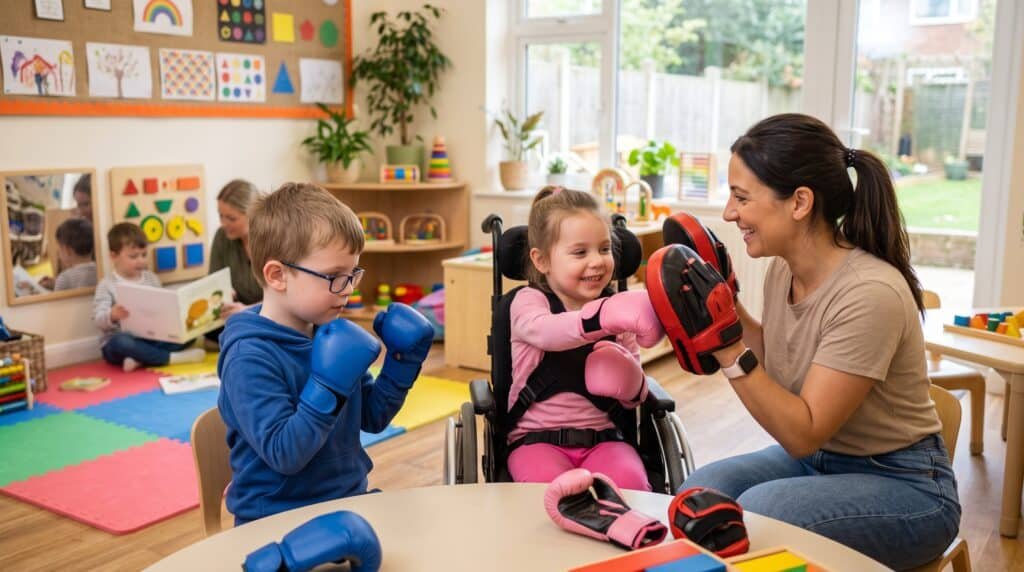
Inside a calm, reservation-only studio, 1-on-1 focus-mitt coaching channels SEN children's energy into focus, coordination, and confidence.
As a former Hong Kong Olympic Boxing Representative and 2026 Youth Olympic Hong Kong Team Coach, my 8 years of full-time coaching in Kowloon have brought all kinds of students through our doors—from busy corporate executives seeking stress relief to youth athletes competing internationally. Yet some of my most meaningful coaching moments involve young visitors with Special Educational Needs (SEN).
When these children first walk into the studio, their eyes either dart restlessly around the room or stay fixed on the floor behind their parents. Tired and hopeful, parents often tell me: "Coach Chan, our son has SEN. We've tried swimming, football, and large martial arts classes, and nothing clicked. Could boxing actually help him?"
For many parents in Hong Kong, the word "boxing" immediately triggers worries about aggression, bruises, or playground fighting. Putting a child with ADHD or Autism into a boxing gym might sound counterintuitive at first glance. Yet if you look beyond Hollywood stereotypes, Olympic boxing—known for over a century as "The Sweet Science"—is one of the most structured, cognitively demanding, and emotionally grounding sports a child can learn. Let's break down the sports science behind why authentic boxing works wonders for SEN children.
1. Understanding SEN in Hong Kong: Why Traditional Group Sports Often Fail
In Hong Kong's mainstream and international school environments, parents of children with Special Educational Needs (SEN) frequently encounter daily hurdles when searching for suitable extracurricular activities. In our studio, we most commonly support children across three neurodevelopmental profiles:
| SEN Profile | Everyday & Classroom Traits | Why Crowded Team Sports Cause Frustration |
|---|---|---|
| 1. ADHD (Attention-Deficit / Hyperactivity Disorder) |
A high-speed brain engine with weak brakes—abundant physical energy, short attention span, and impulsive reactions. | Long waiting lines in 20-kid classes trigger boredom, fidgeting, and constant reprimands from overwhelmed coaches. |
| 2. ASD (Autism Spectrum Disorder) |
Social communication differences, a strong need for predictable routine, and sensitivity to loud noise or crowds. | Chaotic gymnasium noise and unpredictable physical contact can quickly cause sensory overload and meltdowns. |
| 3. DCD (Developmental Coordination Disorder) |
Challenges with motor planning, balance, and left-right coordination, often leading to embarrassment in PE class. | Fast-paced ball games move on without breaking down biomechanics, leaving clumsy learners excluded and discouraged. |
2. 4 Sports-Science Reasons Why Boxing Is a Game-Changer for SEN Kids
Authentic boxing succeeds where crowded group activities fail because its core training mechanics align directly with how neurodivergent brains process sensory input, movement, and reward:
1. Supporting ADHD: Instant Visual Feedback & Dopamine Regulation
Neuroscience shows that children with ADHD do not lack the ability to focus—rather, their prefrontal cortex requires higher-frequency, immediate feedback to generate sufficient dopamine for sustained attention.
During 1-on-1 Focus-Mitt Training (Padwork), the feedback loop is instantaneous: the coach flashes the left mitt, and the child fires a crisp right cross within 0.3 seconds; the coach swings a padded hook, and the child ducks smoothly underneath (Roll). Because a momentary lapse in attention means missing the target, the child's brain naturally locks into calm hyper-focus. Every clean "pop!" against the leather mitt delivers an immediate dopamine reward while constructively channeling excess physical energy (see how padwork sharpens cognitive focus in our Boxing Padwork Training Guide).
2. Supporting Autism (ASD): Predictable "Number Codes" & Proprioceptive Input
Children on the autism spectrum thrive on structure and clear rules. Western boxing is built on an exact, logical numbering system that removes ambiguity.
Instead of overwhelming ASD learners with abstract verbal explanations, we teach through clear numerical sequences: "1 is your lead jab, 2 is your rear cross, 3 is your lead hook—let's drill 1–2–3." Those repeatable combinations act like comforting mental anchors. Furthermore, striking a heavy bag provides deep proprioceptive feedback—sending steady, grounding sensory input through the joints and muscles that calms an overstimulated nervous system and eases anxiety.
3. Improving DCD (Coordination Disorder): Crossing the Midline & Soviet Kinetic-Chain Mechanics
If your child struggles with balance or left-right coordination, boxing is an unmatched neuromuscular training tool.
Under Soviet Boxing Science, every punch is driven from the ground up along an unbroken Kinetic Chain: pushing off the ball of the foot, pivoting the rear heel, rotating the hips, and releasing the punch cleanly. Crucially, boxing requires constant "crossing the midline" movements—throwing a right cross rotates the right shoulder and hip across the body's centerline while the left hand stays glued to the jaw. This bilateral cross-body coordination stimulates communication between the left and right cerebral hemispheres. Paired with the elastic Russian Pendulum Step (Chelnok), children who once tripped while jogging learn to glide forward and backward with poise (explore our footwork system in our HK Boxing Gym Space & Russian Footwork Guide).
4. Emotional Regulation & Resilience: Learning to Breathe Under Fatigue
Meltdowns often happen when a child hits a wall of physical fatigue or frustration. Boxing provides a safe, supportive laboratory to practice self-regulation.
When a child reaches the final 30 seconds of a 3-minute round—arms heavy, heart rate elevated—their instinct may be to quit or lash out. At that exact moment, I pause the timer, kneel to eye level, and coach their breathing: "Stop and look at me. Breathe in through your nose, out through your mouth. Your arms feel tired because they're getting stronger. Hands up—15 seconds left, finish strong!" Completing that final burst teaches children that frustration is temporary and manageable (read our Boxing Champion Mindset & Resilience Guide).
3. Coach Chan's "Tough Love" Philosophy: Patient, Never Fragile
Parents sometimes ask whether I speak in whispers or lower technical standards when coaching SEN students. My answer is always: infinite patience, zero fragility.
Out of sympathy, adults often lower expectations for SEN children, inadvertently depriving them of real mastery. In our studio, I practice respectful, consistent discipline—treating every young boxer as capable of excellence:
- Three Clear Studio Boundaries: First, greet your coach loudly and make eye contact upon arrival; second, once gloves are on, training time is focused time; third, missing a punch is completely fine, but throwing a tantrum is not—take a deep breath and repeat the rep properly.
- Why a Calm, Reservation-Only Studio Matters: Crowded, noisy commercial gyms overwhelm SEN learners. At CKW Boxing in Lai Chi Kok, our Elite Privacy reservation-only studio keeps sessions quiet, structured, and distraction-free (compare 1-on-1 vs. group formats in our Private Coach vs. Group Class Guide).
4. Parent Peace of Mind: CKW Boxing's Two-Tier "Zero Forced Sparring" System
🥊 Coach Chan's Promise to Parents: Every Child Starts Safely at Level 1
Coaching SEN learners takes dedication—sometimes 15 minutes of a 60-minute session goes toward settling pre-class jitters, and a single footwork drill may take three months of patient repetition. Yet when a non-verbal or shy autistic child walks over with a bright smile to offer a confident fist bump—or when an ADHD student who struggled in school completes three focused rounds on the mitts—it is the most rewarding sight in coaching.
To ensure 100% safety and peace of mind for every parent, Chan Ka Wa Boxing (CKW Boxing) enforces a strict two-tier Student Roadmap & Safety Gate System:
- Level 1 — Foundation & Safety Stage (Zero Forced Sparring): All children and teenagers aged 8+ start at Level 1, focusing exclusively on orthodox stance balance, Russian Pendulum footwork, cross-midline coordination, and 1-on-1 focus mitts—with strictly zero forced sparring guaranteed in writing (explore our Kids & Teens Boxing Classes and 1-on-1 Private Boxing Classes).
- Level 2 — Technical Progression (Unlocked Only via Safety Evaluation): Only older, emotionally ready youths who pass a dedicated 3-to-5-minute 1-on-1 coach safety evaluation unlock Level 2 Technical Classes (see how our homegrown youth athletes grow safely from Day 1 in our Youth Olympic Boxing & Chan Yik Kan Feature).
5. FAQ: Boxing for SEN Kids & Youth Classes in Hong Kong
Q1: My child has ADHD and hyperactive tendencies—won't boxing make them more aggressive at school?
The exact opposite happens—structured boxing significantly reduces impulsive aggression. Untrained children often push or lash out because they lack physical outlets and self-regulation tools. At CKW Boxing, Day 1 establishes the unbreakable rule that boxing skills belong strictly inside the studio, while high-engagement mitt work channels excess energy into calm self-control.
Q2: My child has Autism (ASD) and dislikes noisy environments—should we choose 1-on-1 Private Classes or a Group Class?
We strongly recommend starting with our 1-on-1 Private Assessment Trial and 1-on-1 Private Boxing Classes. Every SEN child has unique sensory preferences and communication rhythms. In our 1-on-1 Private Boxing Classes, former HK Olympian Chan Ka Wa tailors instructions inside a quiet, private reservation-only space—and your child can transition to small-group sessions later only if and when they feel completely ready.
Q3: Where is CKW Boxing located in Kowloon, and how do we book a trial for our child?
Our private reservation-only studio is located at Dr Kong Center, 550 Castle Peak Road, Lai Chi Kok, Kowloon (2–5 minutes' walk from Lai Chi Kok MTR Exit B2), welcoming children and teens aged 8 and above. Newcomers enjoy introductory Trial Session rates: HK$250 for a 1-on-1 Private Assessment Trial (full 60 minutes including coordination and posture assessment, regular price HK$800) or HK$100 for a Group Trial Session. Complimentary sanitized loaner gloves are provided, with strictly zero forced sparring and 100% zero hard-selling (check our Weekly Timetable and Class Pricing).
The Rise of China & Taiwan Boxing: A Former HK Olympian Breaks Down Their Training Systems & Takeaways for Hong Kong
Why are China and Taiwan dominating Asian & Olympic boxing? Former HK Olympian Chan Ka Wa compares their systems and shares 3 tactical takeaways for Hong Kong.

5 Most Common Boxing Injuries & How to Prevent Them Using the Soviet Kinetic Chain — A Former HK Olympian’s Guide
Worried about wrist, shoulder, or lower back pain from boxing? Former HK Olympian Chan Ka Wa explains 5 common boxing injuries and Soviet kinetic-chain fixes.
2026 Nagoya Asian Games Boxing Recap: A Former HK Olympian Breaks Down India’s Rise & Tactical Shifts
India topped the 2026 Nagoya Asian Games boxing medal table while Lin Yu-ting claimed 60kg gold. Former HK Olympian Chan Ka Wa breaks down the tactical shifts.
Youth Olympic Boxing & U19 Worlds: Homegrown CKW Boxing Star Chan Yik Kan’s Road to Africa
How tough is Youth Olympic Boxing? Former HK Olympian & 2026 YOG Coach Chan Ka Wa profiles homegrown CKW Boxing star Chan Yik Kan’s U19 Worlds & Africa campaign.
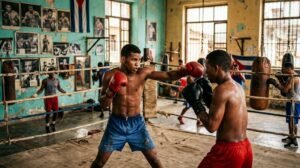
Why Did Cuban Boxing Fall From Dominance? A Former HK Olympian Breaks Down 4 Hard Truths Behind the Dynasty’s Decline
Why did Cuban boxing lose its Olympic throne? Former HK Olympian Chan Ka Wa breaks down 10-point scoring reforms, Central Asian Soviet evolution & defections.
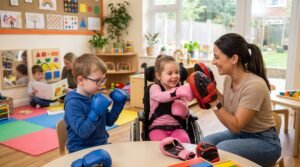
Is Boxing Violent? A Former HK Olympian Explains 4 Reasons Why Boxing Helps SEN Kids (ADHD, Autism & DCD)
Think boxing is too aggressive for SEN children? Former HK Olympian Chan Ka Wa explains how 1-on-1 focus mitts & Soviet footwork boost focus in ADHD & ASD kids.