
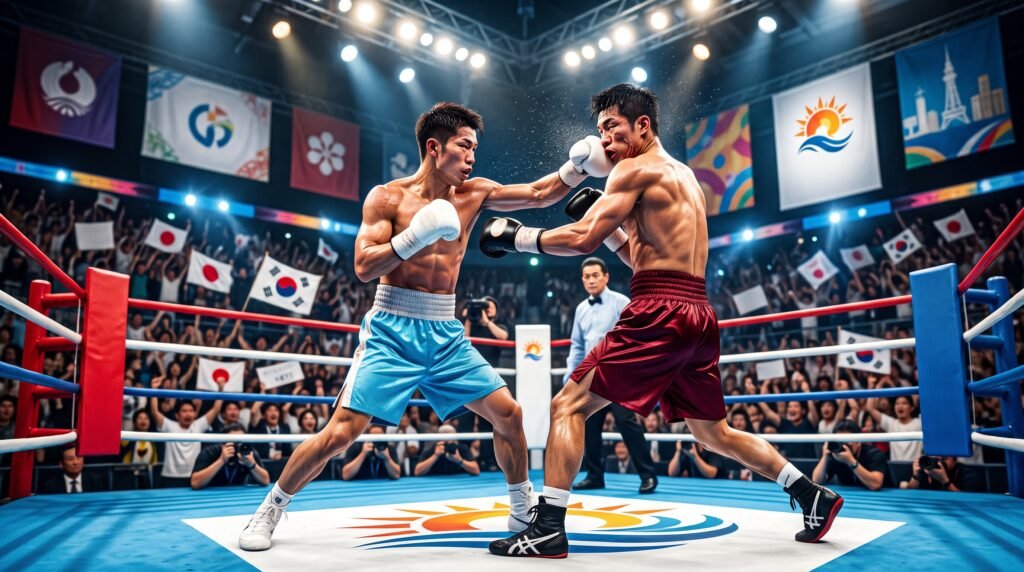
【Coach's Column】2026 Asian Games Boxing in Nagoya Recap! A Former Olympian Breaks Down India's Rise and Massive Tactical Shifts
The nearly two-week-long boxing tournament at the 2026 Aichi-Nagoya Asian Games officially dropped its curtains on October 2nd at the Nishio City General Gymnasium. As a former Hong Kong Olympic boxing representative who transitioned into full-time coaching, I was glued to the live broadcasts almost every single day. To the average spectator, the Asian Games might just be about checking which country won gold. But through the eyes of a professional coach, every Asian Games represents a massive tectonic shift in the Asian boxing landscape and its Tactical Ecosystem.
The results of the 2026 Asian Games can absolutely be described as “shocking”: India made history by dominating the ring with 3 Golds and 3 Bronzes, topping the Asian Games boxing medal tally for the first time. Traditional Central Asian powerhouses Uzbekistan and Kazakhstan remained formidable, but their absolute dominance was visibly eroded. Meanwhile, Taiwan’s Lin Yu-ting, moving up to the 60kg division after weathering massive storms of controversy, proved utterly unstoppable and captured gold.
Today, we are going to skip the boring scorecards. Using the analytical perspective of a former Hong Kong team representative and modern sports science, I am going to deeply deconstruct the 3 massive tactical shifts behind the Nagoya Asian Games, and what these changes mean for the future of Hong Kong boxers stepping onto the international stage.
▍I. The Sudden Rise of India: A Victory of Sports Science and "Heavy-Armor Pressure"
If someone had told you before the tournament that India would crush Uzbekistan and Kazakhstan to become the number one boxing nation in Asia, you would have called them crazy. But the brutal reality of the scorecards proved everything: India officially claimed the throne riding on the 3 gold medals from Ankush Panghal (Men’s 80kg), Parveen Hooda (Women’s 65kg), and Lovlina Borgohain (Women’s 75kg).
How did India experience such a massive explosion in just a few short years? The answer is: Big data monitoring and extreme Strength & Conditioning (S&C).
In the past, Indian boxers had decent technique, but they frequently suffered from a cliff-like drop in stamina (gassing out) by the third round. At this Asian Games, however, Indian fighters showcased a terrifying level of “lactate tolerance.” Facing the signature lateral movement and footwork of Central Asian fighters, the Indian team adopted an incredibly direct tactic: High-Guard Pressure (Heavy-Armor).
Cutting off the ring: Indian fighters completely abandoned pointless, long-distance probing jabs. They maintained an extremely tight high guard and used lateral footwork to corner their opponents into blind spots.
Physical Domination: In close-quarters inside fighting, the Indian boxers’ core strength reigned supreme. They weren’t hunting for one-punch KOs; instead, they used a relentless barrage of Body Shots to break their opponents’ breathing rhythm. This style, which relies heavily on a massive foundation of physical strength, completely suffocated traditional technical fighters who rely on agile movement.
💡 Sports Science in the Ring: India’s success proves that modern boxing can’t just rely on running and hitting the bag! Want to know how to build “heavy armor” through scientific weight training? Check this out: 👉【Boxing S&C】Does Lifting Make You Slower? Former Olympian Unlocks the Ultimate Guide to Explosive Power
▍II. The Tactical Bottleneck of Central Asia: Has the "Russian Footwork" Been Decoded?
When discussing Asian boxing, you absolutely cannot ignore Uzbekistan (2 Golds, 1 Silver, 4 Bronzes) and Kazakhstan (2 Golds, 2 Bronzes). They boast the world’s most elite state-sponsored development systems. But at this Asian Games, we witnessed the Central Asian system facing a severe crisis of being “decoded.”
The greatest pride of Uzbek fighters is their “Pendulum Step” and micro-distance control. They are accustomed to bouncing frantically right on the absolute edge of their opponent’s striking radius, baiting a punch, using a lightning-fast pull-back to create distance, and then instantly springing back in with a counter-punch.
However, in the Nagoya rings, the coaching staffs of various Asian nations had clearly “downloaded” this tactical data. Taking the Chinese and Indian teams as examples, their strategy against Central Asian fighters was highly specific:
Refusing to Reach: When the Uzbek fighters bounced on the outside to provoke an attack, their opponents chose to stand their ground. They absolutely refused to lean their center of gravity forward to throw long straight punches. Because the moment you overextend your punching trajectory, the Russian footwork will inevitably catch your opening for a counter.
Anticipatory Striking on the Landing: Fighters began timing that 0.1-second lag when the Central Asian fighters’ pendulum step “landed.” In that exact fraction of a second when both feet touched the canvas and they couldn’t instantaneously change direction, opponents fired devastating lead hooks.
Central Asian boxing is still world-class, and fighters like Abdulmalik Khalokov still displayed dominance in the Men’s 60kg division. But this Asian Games sent a clear message: the era of relying on one style of footwork to secure victory is over. Ring IQ and tactical diversity are the only ways to maintain supreme dominance.
💡 Deep Dive into Central Asian Boxing: Want to thoroughly understand the underlying logic and training models of Uzbek boxing? I previously led a team deep into their headquarters! Check this out: 👉 【Boxing Analysis】Why is Uzbekistan Boxing So Dominant? A Former Olympian’s Inside Look at Central Asia’s Training Camps
▍III. Lin Yu-ting's Explosive Power: Distance Control and the Aura of a Champion
Undoubtedly, the most highly anticipated match in the women’s division this Asian Games was Taiwan’s Lin Yu-ting in the 60kg gold medal bout. Having weathered the massive storms of the Paris Olympics, Lin moved up from 57kg to 60kg for this tournament. Moving up a weight class is a massive test for any boxer, as you face opponents with vastly superior punch resistance and much heavier knockout power.
Yet, in the final against China’s Yang Chengyu, the 30-year-old Lin Yu-ting delivered a textbook masterclass in Distance Control.
Perfect Exploitation of Geometric Advantages: Facing an opponent with a shorter height and reach, Lin was in no rush to initiate attacks. She transformed her lead jab into a highly precise “ruler.” Every time her opponent tried to duck her head and slip inside, Lin’s jab landed on her forehead like a cruise missile, instantly disrupting her opponent’s forward momentum.
Icy-Cold Counter-Punching: In the third round, when her trailing opponent launched a desperate, frantic high-pressure assault, Lin did not get dragged into a messy brawl. She utilized incredibly slick lateral movement and pivots to continuously deflect the linear impact of her opponent, ultimately securing the gold medal with a flawless 5-0 undisputed victory.
Lin Yu-ting’s victory wasn’t just a triumph of technique; it was the ultimate manifestation of the “Champion Mindset.” Facing external doubts, the pressure of moving up a weight class, and the ferocious comeback attempts of her opponent in the finals, her unwavering composure—as if a mountain could collapse in front of her without her blinking—is exactly the highest mental realm every aspiring boxer must study.
💡 Forge an Iron Mindset: How do you maintain absolute cerebral calmness in a high-pressure ring like Lin Yu-ting? Check this out: 👉【Boxing Psychology】Want to Win? A Former Olympian Unlocks the 3 Core Champion Mindsets
▍IV. A Revelation for Hong Kong Boxers: The Brutal Reality of Amateur Boxing's "Professionalization"
After watching the 2026 Nagoya Asian Games, as a former Hong Kong representative, I have profound takeaways. The line between modern Olympic/Asian Games amateur boxing and Professional Boxing has become increasingly blurred.
Ever since the IBA’s old scoring system was overthrown and judges adopted the 10-Point Must system, the scoring criteria have undergone an earth-shattering shift. The old era of “touch and run” point-scoring is completely dead. The judges at this Asian Games placed an extreme premium on two things:
Ring Generalship: Are you dictating the pace of the fight? Are you backing your opponent into the ropes, or are you spending the whole fight running away?
Effective Damage: Ten soft, pitty-pat jabs will never score as highly as one clean, heavy straight punch that violently snaps the opponent’s head back.
For young boxers in Hong Kong, this is a massive wake-up call. Boxing gyms in Hong Kong are generally smaller, which makes it easy for us to develop excellent close-range reflexes, but we often lack the stamina reserves required for long-distance pressure and sustained volume output. If Hong Kong boxers want to break through in future Asian Games or international tournaments, we must completely abandon the “light touch” mentality, inject a complete Kinetic Chain force-generation mechanic into every punch, and learn how to project overwhelming aggression from the center of the ring.
💡 Stepping Stones to the International Stage: Want to know which local Hong Kong competitions can help you build experience and step-by-step earn a spot on the HK Team or at the Asian Games? Check this out: 👉 【HK Boxing Guide】Want to Compete? A Former Olympian Breaks Down 3 Amateur Tiers & Rules
▍The Ring is Always Evolving, Are You Ready?
Although the 2026 Aichi-Nagoya Asian Games boxing tournament has concluded, the tactical wealth and shockwaves it left behind will be studied for years to come.
India’s forceful rise tells us that scientific training can overthrow traditional hegemonies; the setbacks faced by the Central Asian giants remind us that a one-dimensional tactic is destined for obsolescence; and Lin Yu-ting’s back-to-back dominance perfectly illustrates the true art of the ring.
Boxing is called the “Sweet Science” precisely because it is perpetually evolving. If you are still stuck in the mindset that “boxing only relies on brute force and blind courage,” you are destined to not even survive the first round.
🥊 Want to Keep Up with World-Class Boxing Tactics?
Tired of being a “Heavy Bag Hero” who only knows how to blindly push the bag? Want to personally experience top-tier coaching that perfectly blends modern sports science with former Soviet tactics?
Chan Ka Wa Boxing is personally led by a former Hong Kong Olympic representative. We closely monitor the tactical evolution of the world’s highest-level competitions, distilling the essence of Asian Games and Olympic-level combat into a training system perfectly tailored for Hong Kongers.
(Want to know how a professional coach can rapidly correct your technique? Check this out: 👉【Boxing Guide】PT vs Group Class: Which is Better? HK 1-on-1 Boxing Costs and Benefits

【Boxing Analysis】2026 Asian Games Boxing Recap: A Former Olympian Breaks Down India’s Rise & Tactical Shifts
The 2026 Asian Games boxing tournament in Aichi-Nagoya just concluded! A former HK Olympic coach analyzes India’s shocking dominance, the decoding of Central Asian footwork, and Lin Yu-ting’s masterclass in distance control.
【Boxing News】Youth Olympic Boxing Decoded! HK Prospect Chan Yik Kan Heads to Africa
How brutal is Youth Olympic Boxing? A former Hong Kong Olympic representative breaks down the U19 World Boxing Championships and previews CKW Boxing prospect Chan Yik Kan’s upcoming expedition to Africa.

【Boxing Analysis】Why Did Cuban Boxing Decline? A Former Olympian Breaks Down 4 Brutal Truths
Once the untouchable gods of Olympic boxing, why has Cuba fallen from grace? A former Hong Kong Olympic representative analyzes the 4 brutal truths behind the decline of Cuban boxing, from scoring system changes to the rise of Central Asian fighters.

【Coach’s Column】Is Boxing Violent? Former Olympian Explains 3 Reasons Why Boxing is the Best “Antidote” for SEN Children!
Many parents think boxing is violent, but for SEN children (ADHD, Autism), it’s a miracle sport for training focus and emotional control! A former Hong Kong Olympic representative explains how padwork, footwork, and discipline rebuild confidence and coordination in kids with Special Educational Needs.
【Boxing Science】How to KO in Boxing? Former Olympian Unlocks 3 Essential Rules
Want to know how to KO in boxing? A former Olympic coach breaks down the science of knockouts, the kinetic chain, timing, and why headhunting gets you KO’d.

【Coach’s Column】Want to Learn Boxing But Afraid to Take the First Step? A Former Olympian Breaks Down 4 Mental Barriers and Prep Tips for Boxing Beginners
Want to learn boxing but worried about your fitness, coordination, or getting hurt? A former Hong Kong Olympic coach breaks down the 4 biggest mental barriers for boxing beginners and explains how to take your first step safely.